


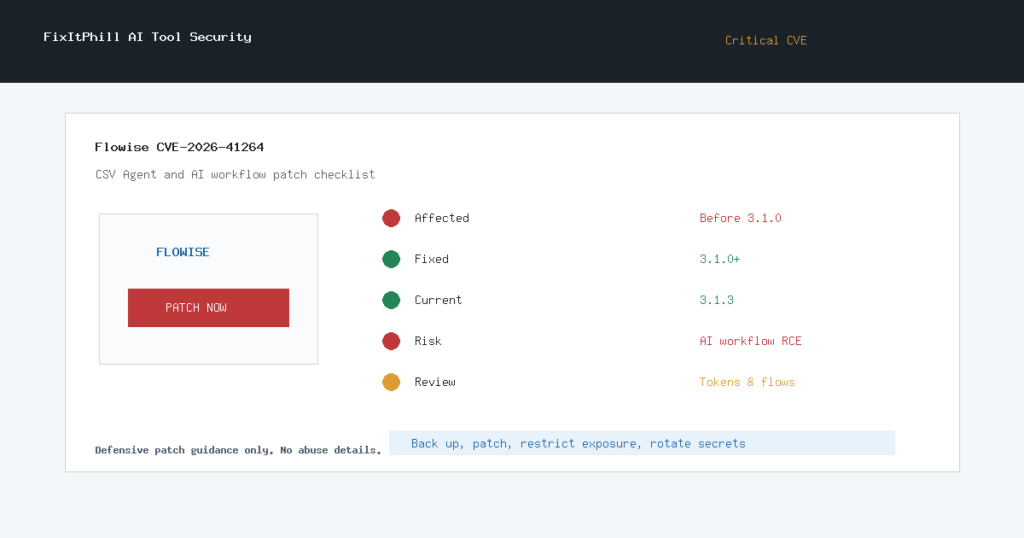
Update for July 11, 2026 at 00:40 UTC: Rapid7 surfaced fresh public-exploit tooling for CVE-2026-41264, a critical Flowise issue affecting CSV Agent chatflows before 3.1.0. NVD rates the issue critical, and Flowise has released fixed versions.
Flowise is often used for internal AI agents, customer-facing chatflows, pilot automation, and admin-side workflow experiments. If a Flowise deployment is exposed to users, customers, contractors, or the public internet, treat this as a same-day patch item.
Who Is Affected
- Flowise deployments before 3.1.0.
- Chatflows that use the CSV Agent feature.
- AI demos, staging systems, lab servers, and internal tools that were left reachable from the internet.
- Hosting, agency, SaaS, and IT teams that let customers or non-admin users submit prompts to Flowise workflows.
Flowise published 3.1.0 as the fixed release for this advisory. During this pass, the latest official GitHub release was 3.1.3.
What To Do Now
- Back up the Flowise host, environment configuration, credentials store, and workflow export before changing the service.
- Update Flowise to 3.1.0 or newer. Prefer the latest stable release if your deployment process allows it.
- Until the update is complete, disable or restrict any chatflow that uses CSV Agent and accepts input from untrusted users.
- Put exposed Flowise systems behind VPN, SSO, IP allowlisting, or another access control layer.
- Review recent Flowise users, chatflow edits, integrations, files, environment variables, and connected service tokens.
- Rotate API keys and integration secrets if the Flowise host was exposed and you cannot prove it was clean.
- After patching, test each business-critical chatflow with safe sample data before returning it to customer use.
Hosting And Agency Checklist
- Search VPS, Docker, Kubernetes, and app-platform inventories for Flowise containers or Node.js services.
- Prioritize internet-facing Flowise dashboards, demo agents, and customer pilot systems.
- Check whether CSV Agent is enabled in any active workflow.
- Move public demos behind authentication or take them offline until patching and access review are complete.
- Document which secrets were connected to each Flowise instance before deciding whether rotation is required.
- Add Flowise to the normal AI-tool patch inventory so it does not become another forgotten lab service.
Exploitation Status
CISA KEV did not add this CVE during this pass. The risk is still urgent because NVD lists the issue as critical and Rapid7 now shows fresh public-exploit-tooling signal. Do not wait for KEV before patching exposed Flowise systems.
FixItPhill Guidance
AI workflow servers should be treated like app servers, not throwaway demos. If Flowise can reach files, APIs, credentials, tickets, sensitive records, or internal tools, it belongs in the same patch and access-review process as any other production service.
Patch first, restrict exposure second, then review tokens and recent workflow changes. If a Flowise install was only used for testing, shut it down until someone owns the maintenance path.