


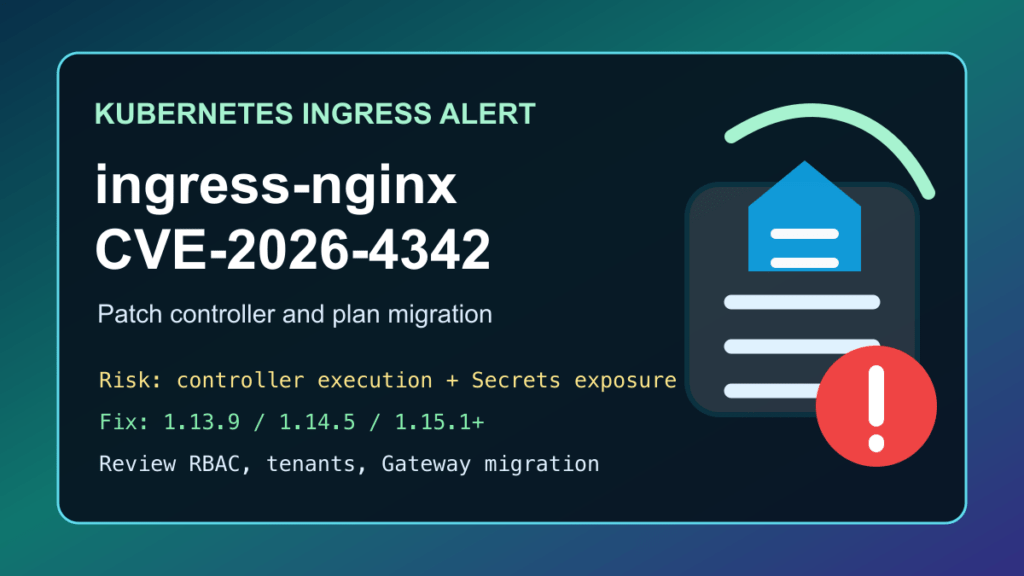
Impact statement: CVE-2026-4342 is a high-severity ingress-nginx vulnerability that matters for Kubernetes clusters where developers, customers, CI/CD jobs, or tenants can create or change Ingress resources. Kubernetes rates it CVSS 8.8. A risky Ingress change can lead to code execution in the ingress-nginx controller context and may expose Kubernetes Secrets that the controller can read.
This is not the same as the standalone NGINX web server issue from May 2026. This one affects the community Kubernetes ingress-nginx controller. If your cluster does not run ingress-nginx, this CVE does not apply. If it does run ingress-nginx, treat this as a cluster-edge maintenance item, especially on shared hosting, SaaS, lab, CI, MSP, or multi-tenant Kubernetes environments.
Affected ingress-nginx versions
- ingress-nginx versions before 1.13.9
- ingress-nginx 1.14.x versions before 1.14.5
- ingress-nginx 1.15.0
The fixed release lines listed by Kubernetes are 1.13.9, 1.14.5, and 1.15.1. Clusters using a managed Kubernetes service should also check the provider advisory because some providers package or pin ingress controller builds differently.
Why hosting and platform teams should care
The ingress controller sits on the public edge of many Kubernetes clusters. If a lower-privileged user can submit Ingress changes, a controller-level issue can turn a namespace-level foothold into wider cluster exposure. The biggest risks are service disruption, unexpected routing changes, controller compromise, and Secrets exposure through the permissions granted to the controller.
- Shared clusters: review who can create or edit Ingress resources in every namespace.
- Hosting platforms: check customer-facing Kubernetes, staging, and CI clusters, not only production.
- MSP and support teams: include customer clusters where ingress-nginx was installed by Helm, GitOps, kubeadm add-ons, or old bootstrap templates.
- Backup infrastructure: make sure etcd snapshots, GitOps manifests, and ingress-controller Helm values are recoverable before changing the edge path.
Safe inventory checks
These checks are normal administrative inventory checks. They do not validate exploitability against a target and should be run only on clusters you own or administer.
kubectl get pods --all-namespaces --selector app.kubernetes.io/name=ingress-nginx
kubectl get deployment --all-namespaces -o wide | grep -i ingress-nginx
helm list --all-namespaces | grep -i ingress-nginx
For each matching deployment, record the namespace, controller image, Helm chart version, replica count, public load balancer, and any custom values or templates. If the controller image is below a fixed line, schedule an update.
Patch and rolling maintenance guidance
Plan this like an edge load balancer change. A hurried ingress-controller update can break TLS termination, WebSocket behavior, upload limits, redirects, gRPC, custom error pages, or application health checks.
- Export current Helm values or deployment manifests before changing anything.
- Confirm recent etcd, GitOps, and cluster backup coverage.
- Test the update in staging with representative HTTP, HTTPS, WebSocket, API, and large-upload paths.
- Upgrade ingress-nginx to a fixed line: 1.13.9, 1.14.5, 1.15.1, or a vendor-supported newer build.
- Roll replicas gradually where possible and watch controller readiness, reload errors, service endpoints, and external load balancer health.
- After the rollout, verify important customer routes, TLS certificates, redirects, API status codes, and application logs.
If you use Helm, follow the ingress-nginx upgrade documentation and keep your existing values under review. If you manage the Deployment directly, update the controller image to the fixed version your environment supports and let Kubernetes roll the controller pods.
Temporary mitigation while patching
Mitigation should reduce who can change ingress behavior until the fixed controller is in place. It should not become a permanent substitute for updating.
- Restrict Ingress create/update permissions to trusted platform administrators.
- Review CI/CD service accounts that can apply Kubernetes manifests.
- Use an admission-control policy to reject risky custom controller configuration features that your applications do not require.
- Reduce the ingress controller service account permissions where your architecture allows it.
- Consider isolating untrusted tenants onto separate clusters or separate ingress controllers.
What logs and changes to review
- Kubernetes audit logs for unexpected Ingress creation or modification.
- GitOps pull requests and deployment history for ingress-related manifest changes.
- ingress-nginx controller logs for repeated reload failures, rejected configuration, or unusual route changes.
- RBAC changes that granted users or automation broader networking permissions.
- Secret access, unexpected certificate changes, and application sessions on public routes served by the controller.
If you find suspicious ingress changes, preserve audit evidence, rotate secrets that may have been exposed to the controller, review service account tokens, and rebuild affected controller pods from known-good manifests after patching.
Long-term replacement guidance
There is a second reason to act: the community ingress-nginx project has been retired by Kubernetes SIG Network and the Security Response Committee. Existing deployments may keep running, but long-term platform plans should move toward a maintained ingress or Gateway implementation.
- Preferred strategic path: evaluate Kubernetes Gateway API where it fits your platform model.
- Ingress-controller path: choose a maintained controller supported by your cloud, distro, or vendor, such as Traefik, HAProxy, Kong, Envoy/Gateway API implementations, or a supported NGINX-based commercial controller.
- Migration safety: run the old and new controllers side by side, move low-risk hostnames first, then migrate customer or revenue-critical routes after testing.
- Rollback planning: keep DNS TTLs, load balancer records, GitOps manifests, and TLS certificate ownership clear before the cutover.
What to tell customers
Tell customers that a Kubernetes ingress controller update is being applied to reduce risk from a high-severity configuration injection issue. Most application owners should not need to change code, but they should test login, checkout, API, upload, and callback flows after the maintenance window. If you host customer Kubernetes workloads, also explain whether they can create their own Ingress resources and whether that permission will change.