


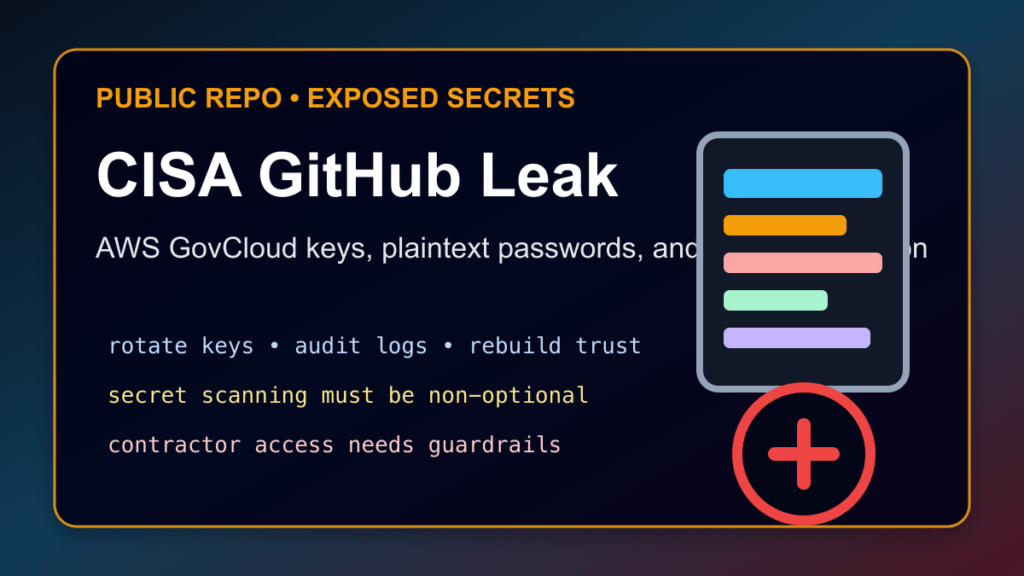
May 20, 2026 update: the CISA GitHub leak is not just embarrassing government news. It is a clean case study in what happens when production credentials, cloud access, build notes, and contractor workflows drift into a public repository. If a security agency can have this happen, every MSP, hosting provider, developer, and homelab admin should assume their own GitHub, GitLab, Bitbucket, backups, CI logs, and laptop sync folders need another look.
Brian Krebs first reported that a contractor tied to the Cybersecurity and Infrastructure Security Agency had maintained a public GitHub repository that exposed credentials for AWS GovCloud and internal CISA/DHS systems. GitGuardian researcher Guillaume Valadon published the disclosure timeline, saying the repository was discovered on May 14, 2026, had been exposed since November 2025, and was taken offline on May 15.
We are not linking to copies of the repository, publishing sensitive file names, or repeating any credentials. The public defensive lesson is enough: long-lived cloud keys, plaintext passwords, certificates, internal deployment notes, Git history, and contractor laptops do not belong in public source control. Once a secret is committed, deleting the current file is not enough because Git history, clones, caches, screenshots, and third-party indexing may already exist.
What reportedly happened
- KrebsOnSecurity reported that the exposed repository contained credentials for several highly privileged AWS GovCloud accounts and many internal CISA systems.
- GitGuardian said the public repository contained 844 MB across the working tree and Git history, including CI/CD material, Kubernetes and ArgoCD files, Terraform, GitHub Actions workflows, documentation backups, and references to AWS accounts and identity paths.
- TechCrunch covered the incident as a major credential exposure, noting that CISA had not publicly confirmed evidence of a breach from the exposure at the time of its report.
- Axios reported that Sen. Maggie Hassan requested an urgent classified briefing from acting CISA director Nick Andersen.
- Dark Reading added operational context, including GitGuardian’s warning that a public repository can expose the map of cloud infrastructure and software supply-chain workflows, not just a few passwords.
Why this matters for hosting providers and admins
This is the same failure pattern that hurts smaller teams every week: a personal repo, a contractor account, a backup folder, a debug export, or a copied config gets treated like a private notebook. The difference here is the agency name and the sensitivity of the reported environment. The practical risk is broader than “someone saw a key.” A repository can include enough context to show how systems are built, which identity providers are trusted, how deployments happen, where packages live, and which logs or backups might reveal more access.
That is why hosting companies, SaaS teams, web developers, and VM admins should treat this as a tabletop exercise. If a public repo appeared tomorrow with one of your customer-panel API keys, backup scripts, SSH config notes, Kubernetes manifests, Terraform state exports, or WordPress deployment logs, would you know within minutes, or would a stranger have to tell you?
What to do today
- Search your public footprint: review public GitHub organizations, personal repos used by staff, old forks, gists, documentation repos, automation repos, and archived project mirrors.
- Enable secret scanning and push protection: GitHub documents how to secure secrets and how push protection blocks hardcoded credentials before they land. These controls should be treated as guardrails, not optional warnings.
- Use a public exposure monitor: GitGuardian’s public monitoring documentation explains the idea: watch public sources for secrets associated with your organization, not only repos you remember owning.
- Rotate exposed credentials immediately: AWS says human users should use federation and temporary credentials when possible, while workloads should use IAM roles instead of long-lived keys. Review the AWS IAM best practices and the AWS access key guidance.
- Audit use after exposure: review CloudTrail, identity-provider logs, GitHub audit logs, CI/CD runner logs, package registry access, artifact repository access, VPN logs, administrator logins, and any service that accepted the exposed credential class.
- Kill plaintext password storage: spreadsheets, browser exports, OneNote dumps, chat messages, and “temporary” text files become permanent once they enter Git history or a synced backup.
- Review contractor controls: contractor accounts should be in managed organizations, protected by SSO/MFA, monitored by audit logging, bound by least privilege, and blocked from using personal repositories as work transfer points.
For cPanel, WordPress, and web-hosting teams
The same pattern can expose WHM API tokens, backup credentials, deployment keys, database passwords, SMTP credentials, CDN API tokens, DNS tokens, and WordPress maintenance scripts. If you manage customer sites, check your own tooling before this becomes your headline. Start with the cPanel/WHM security update checklist, the cloud storage access-control guide, and the npm supply-chain response guide. The mechanics are different, but the defensive cycle is the same: inventory, rotate, rebuild, verify, and watch logs.
If your team uses VM templates, admin workstations, or private-cloud tooling, also review the VMware/Broadcom VM hosting checklist. A credential leak does not stay in “developer land” if the same identity can reach hypervisors, backup consoles, package registries, cloud accounts, or customer control panels.
Bottom line
CISA’s public GitHub policy says the agency develops software in the open while protecting sensitive information. That distinction is the whole story. Open source is not the enemy. Public repositories are not the enemy. The failure is letting private operational material, secrets, and internal deployment context cross into a public channel without hard stops and fast revocation.
For defenders, the lesson is blunt: do not wait until a researcher, journalist, customer, or attacker finds your keys. Assume secrets have leaked somewhere, build the process to find them quickly, rotate them without drama, and make it impossible for one tired admin or contractor to turn off the guardrail that would have saved the day.
Source links and further reading
- KrebsOnSecurity: CISA Admin Leaked AWS GovCloud Keys on GitHub
- GitGuardian: How We Got a CISA GitHub Leak Taken Down in Under a Day
- TechCrunch: CISA exposed passwords and cloud keys to the open web
- Axios: Senator requests classified briefing on CISA credentials leak
- Dark Reading: CISA exposes secrets and credentials in public repo
- CISA GitHub and open-by-default development policy
- GitGuardian State of Secrets Sprawl 2026