


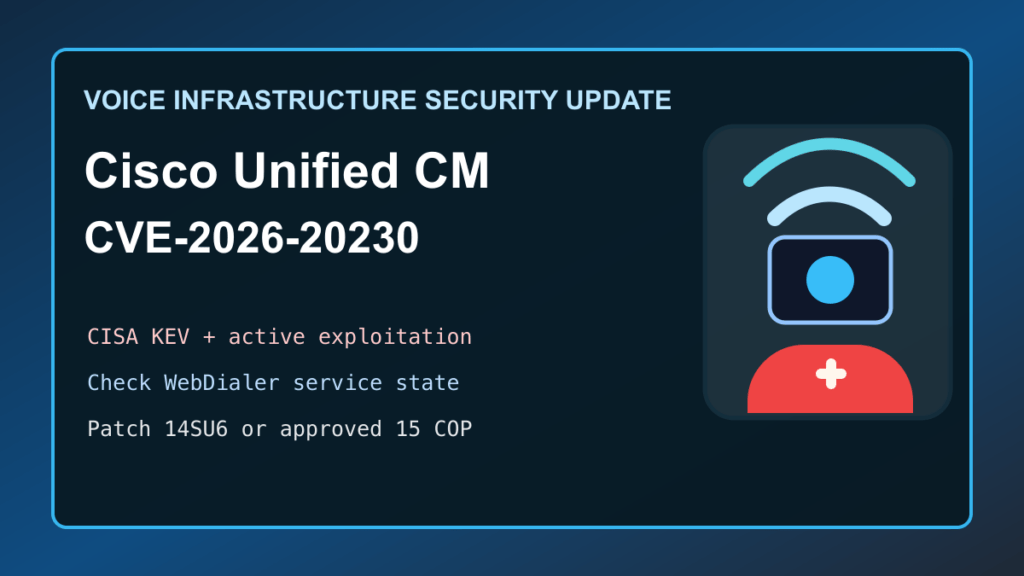
Cisco Unified CM CVE-2026-20230 is now an urgent voice-infrastructure patch item, not a routine Cisco maintenance note. CISA added the flaw to the Known Exploited Vulnerabilities catalog on June 25, 2026, and Cisco updated its advisory on July 1, 2026 to say it is aware of active exploitation.
The issue affects Cisco Unified Communications Manager and Cisco Unified Communications Manager Session Management Edition when the Cisco WebDialer Web Service is enabled. Cisco says WebDialer is disabled by default, but hosting providers, managed service teams, schools, healthcare offices, call centers, and businesses with older telephony integrations should verify their own systems instead of assuming the default still applies.
What Changed
- Cisco lists CVE-2026-20230 as a Critical advisory for Unified CM and Unified CM SME.
- CISA added the vulnerability to the KEV catalog on June 25, 2026 with a June 28, 2026 due date for covered federal systems.
- Cisco updated the advisory on July 1, 2026 with active-exploitation awareness.
- The vulnerable condition requires Cisco WebDialer Web Service to be enabled.
- Cisco says there is no full workaround, but WebDialer can be disabled as a temporary mitigation when the business can tolerate the feature loss.
- Cisco lists Unified CM and Unified CM SME 14SU6 as fixed for the 14 release line.
- Cisco lists Unified CM and Unified CM SME 15SU5, expected in September 2026, or a version-specific COP patch as the fixed path for the 15 release line.
Why Hosting And IT Teams Should Care
Unified CM is often treated as phone-system infrastructure, but it can sit close to identity, directory, messaging, contact-center, SIP trunk, voicemail, and remote-support workflows. A compromise path through the call-control plane can disrupt business operations even when the public website, email, and billing portal are otherwise healthy.
Cisco describes the impact as an unauthenticated remote SSRF condition that can allow files to be written to the underlying operating system and later used for root-level escalation. That makes this a high-priority check for any exposed or broadly reachable Unified CM administrative environment.
Who Should Act Now
- Organizations running Cisco Unified Communications Manager or Unified CM Session Management Edition.
- Managed IT providers that inherited customer voice clusters, call-center platforms, or older Cisco collaboration deployments.
- Hosting and SaaS teams that expose telephony admin services through VPN, jump hosts, remote management networks, or provider firewalls.
- Schools, healthcare offices, local governments, and branch-heavy businesses where phone outages have direct operational impact.
- Security teams that track CISA KEV items for risk-based patching, cyber insurance, or customer compliance reports.
Immediate Triage
- Inventory every Cisco Unified CM and Unified CM SME node, including publisher and subscriber nodes.
- Record the current major release, service update level, node role, cluster health, licensing status, and support-download access.
- Check whether Cisco WebDialer Web Service is enabled in Cisco Unified Serviceability.
- Review whether Unified CM administration is reachable only from trusted management networks.
- Confirm that disaster-recovery backups, configuration exports, and console access are available before making changes.
- Open a maintenance window that accounts for phone registration, SIP trunk behavior, voicemail, contact-center routing, and remote-user impact.
Temporary Mitigation
If you cannot patch immediately, evaluate disabling Cisco WebDialer Web Service until the fixed software can be applied. Cisco documents this as a mitigation, not a replacement for patching. Check business impact first because WebDialer-dependent click-to-call or integration workflows may stop working.
For a defensive status check, use Cisco Unified Serviceability and review the Cisco WebDialer Web Service state under Feature Services. If the service is enabled and your environment does not require it, plan a controlled disablement through the Cisco-documented Service Activation workflow, then verify phone, application, and help-desk behavior afterward.
Patch Path
- Unified CM / Unified CM SME 14: Cisco lists 14SU6 as the first fixed release.
- Unified CM / Unified CM SME 15: Cisco lists 15SU5, expected in September 2026, or a version-specific COP patch.
- Read the Cisco advisory and patch README for your exact release before applying a COP file or service update.
- Download software only from Cisco or an authorized Cisco support path tied to your entitlement.
- If entitlement or download access is unclear, contact Cisco TAC or your Cisco partner before the maintenance window.
Cluster-Safe Maintenance Notes
- Back up the cluster with the supported Disaster Recovery System workflow before patching.
- Confirm replication and cluster health before touching publisher or subscriber nodes.
- Patch in a sequence that matches Cisco guidance and your local failover plan.
- Watch phone registrations, SIP trunks, voicemail integration, contact-center queues, SSO, LDAP sync, Jabber, Webex, and emergency-calling workflows.
- Keep a rollback plan that includes the backup location, console access, support contact, maintenance bridge, and customer notification path.
After-Patch Verification
- Confirm each node reports the intended fixed release or approved COP state.
- Verify Cisco WebDialer Web Service is either intentionally disabled or intentionally re-enabled after patching.
- Test internal calling, inbound calling, outbound calling, voicemail, hunt groups, call queues, SIP trunks, and remote-user calling.
- Review Unified CM logs, admin audit events, system file-change indicators, and upstream firewall or VPN logs from the exposure window.
- Confirm management access is limited to administrator networks, jump hosts, or VPN paths.
- Document the version change, service state, customer impact, and any follow-up investigation.
Customer Communication
Keep customer notices practical. State that Cisco released and updated a Critical Unified CM security advisory, that CISA has listed it as known exploited, that WebDialer-enabled systems need urgent review, and that a maintenance window may affect calling or contact-center services. Do not include technical attack details in public tickets, status pages, or customer emails.
Related FixItPhill Guidance
- Cisco SD-WAN CISA KEV patch checklist
- Progress Kemp LoadMaster CVE-2026-8037 patch checklist
- WHMCS security maintenance update checklist
- HAProxy load balancer upgrade and backend-drain checklist