


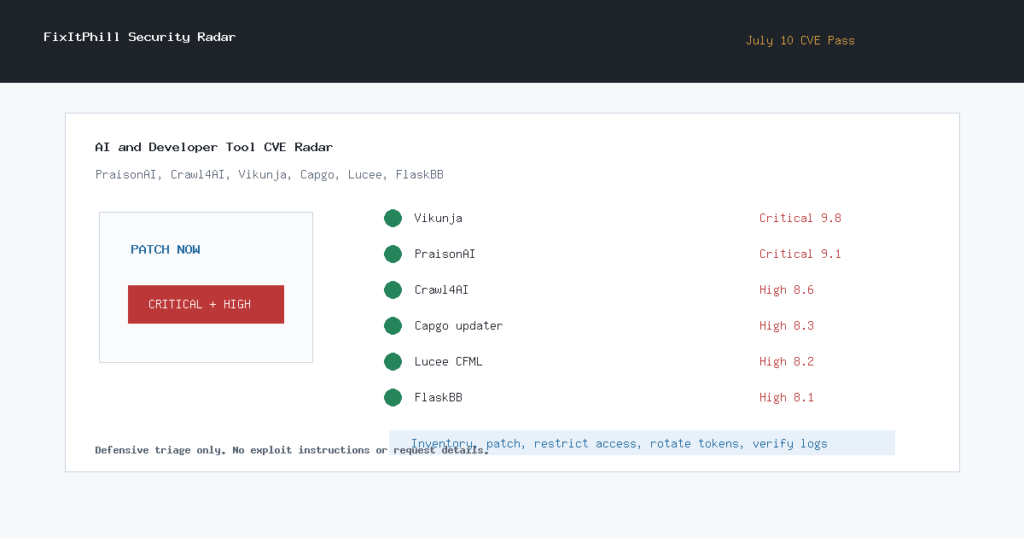
Radar window: July 10, 2026, 14:00-16:00 UTC. NVD added a new group of critical and high CVEs affecting self-hosted AI tools, developer utilities, project-management software, app update infrastructure, CFML servers, and forum software.
This is not a WordPress plugin batch like the earlier July 10 pass. The reader action is for hosting admins, internal IT teams, SaaS operators, and developers who have been testing AI agents or self-hosted tools on public VPS, Docker, staging, or customer support infrastructure.
CISA KEV did not add new entries during this pass. The publish-worthy change came from the post-14:00 UTC NVD high and critical publication window, with GitHub Security Advisory and vendor-adjacent references for several affected projects.
Highest Priority Checks
| Product | CVE | Severity | What admins should do |
|---|---|---|---|
| Vikunja | CVE-2026-56765 | Critical, 9.8 | Update to 2.2.1 or newer. Review shared links, project access, and attachment history on exposed self-hosted instances. |
| PraisonAI | CVE-2026-61444 | Critical, 9.1 | Update to 4.6.78 or newer. Restrict public access to AI job and deployment services until patched and reviewed. |
| Crawl4AI | CVE-2026-56261 | High, 8.6 | Update to 0.8.7 or newer. Block AI crawler services from reaching internal-only networks, cloud metadata, and private service ranges. |
| PraisonAI and praisonaiagents | CVE-2026-60091, CVE-2026-61434, CVE-2026-61437 | High, 7.2-8.8 | Patch PraisonAI to 4.6.78 or newer and praisonaiagents to 1.6.78 or newer. Audit workflows, job history, and service credentials. |
| Capgo / capacitor-updater | CVE-2026-56254, CVE-2026-56279, CVE-2026-56305 | High, 7.0-8.3 | Update to 12.128.2 or newer. Review update distribution trust, organization membership, account sessions, and billing/admin access. |
| Lucee CFML Server | CVE-2026-29519 | High, 8.2 | Check the active Lucee release line and apply the vendor-fixed build for that branch. Keep admin surfaces behind VPN or trusted access while patching. |
| FlaskBB | CVE-2026-22659 | High, 8.1 | Patch to a fixed release or vendor commit when available. Review moderator accounts and recent topic moderation actions. |
Why This Matters For Hosting Teams
AI and developer tools are often installed quickly for experiments, demos, support automation, or internal workflow testing. That creates an exposure problem: these services may have broad file, network, model, workflow, or application credentials even when they were never meant to be internet-facing.
The safer response is to treat this batch as an inventory check. Search for PraisonAI, Crawl4AI, Vikunja, Capgo, Lucee, and FlaskBB across VPS, Docker hosts, staging servers, customer portals, and developer workstations. Patch first, then restrict access so only trusted users and networks can reach the service.
Backup-First Response
Before changing production systems, take a fresh backup or VM snapshot. For self-hosted apps, include the database, uploaded files, configuration, secrets inventory, and container or package version state. For app update systems, preserve enough audit data to understand what update packages, users, and organizations were active before maintenance.
After patching, rotate service tokens if exposure cannot be ruled out, review recent administrative sessions, check for new users or unexpected workflow changes, and verify that the application still works from a clean browser session. For AI or crawler tools, also confirm that outbound access to internal-only addresses is blocked by network policy, not just by application settings.
Safe Exposure Reduction
- Move AI job runners, crawlers, and agent dashboards behind VPN, SSO, or a private network.
- Block application containers from reaching cloud metadata and internal control-plane services unless explicitly required.
- Separate experimental AI tools from customer production data, billing systems, backup systems, and hosting control panels.
- Review app updater pipelines for signing, release, and organization-access assumptions.
- Keep CFML and forum admin areas behind trusted access, especially during maintenance windows.
How FixItPhill Is Tracking This Pass
This post is based on the July 10 NVD high/critical publication window from 14:00-16:00 UTC, GitHub Security Advisory references where available, the CISA KEV comparison against the previous pass, and public FixItPhill duplicate searches. No active exploitation was confirmed during this pass, but the severity and exposure profile make these worth handling before normal monthly maintenance.
Related defensive reading: Gitea Docker reverse proxy auth patch checklist, July 10 WordPress CVE radar, and how to back up WordPress in cPanel and WHM.
Sources
- NVD: CVE-2026-56765 and Vikunja GitHub advisory
- NVD: CVE-2026-61444, CVE-2026-60091, CVE-2026-61434, and CVE-2026-61437
- PraisonAI GitHub advisory GHSA-g6j7-pffp-8whg, GHSA-4w49-gwv8-fpjg, GHSA-cv3g-hj65-pcfh, and GHSA-4gfv-wg42-7jw5
- NVD: CVE-2026-56261 and Crawl4AI GitHub advisory
- NVD: CVE-2026-56254, CVE-2026-56279, CVE-2026-56305, and Capgo GitHub advisories GHSA-j2f4-4pfc-p8rx, GHSA-fch8-pp28-mw2x, and GHSA-rjr5-qxqj-cx8g
- NVD: CVE-2026-29519
- NVD: CVE-2026-22659 and FlaskBB GitHub advisory