
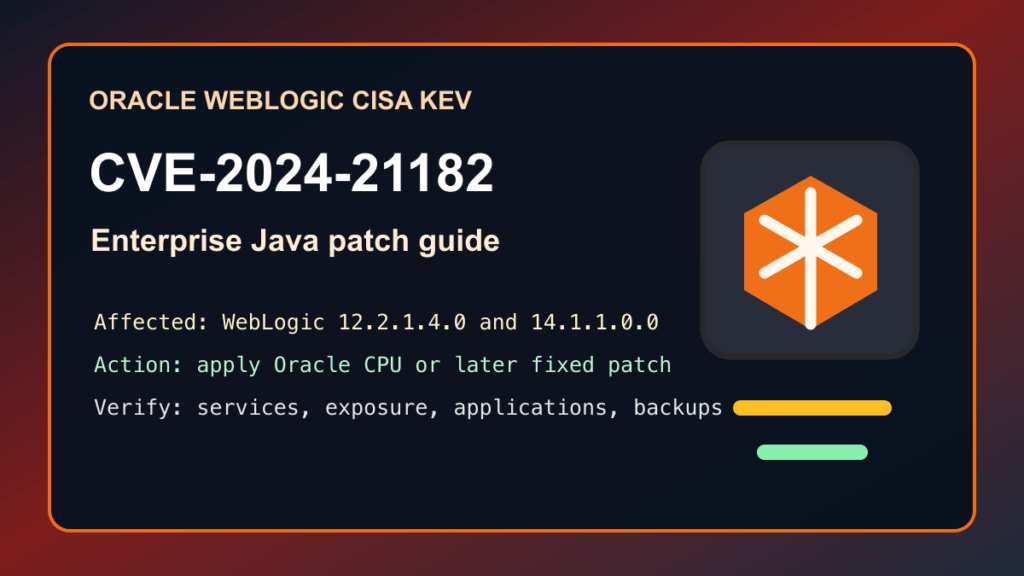
June 1, 2026 update: CISA added CVE-2024-21182 in Oracle WebLogic Server to the Known Exploited Vulnerabilities catalog. CISA lists a June 4, 2026 due date for covered agency action, which is a good practical urgency marker for private-sector teams too.
Plain-English impact: Oracle and NVD describe CVE-2024-21182 as an easily exploitable Oracle WebLogic Server vulnerability in the Core component. An unauthenticated attacker with network access through WebLogic's T3 or IIOP exposure can compromise the server's accessible data. The issue is rated CVSS 7.5 High for confidentiality impact.
Affected WebLogic versions
Oracle and NVD list the supported affected WebLogic Server versions as 12.2.1.4.0 and 14.1.1.0.0. Oracle addressed the issue in the July 2024 Critical Patch Update, so any still-running WebLogic environment that missed that CPU should be treated as exposed until verified.
Who should care
- Enterprise Java teams running WebLogic applications for finance, ERP, identity, customer portals, or internal business systems.
- Hosting providers and managed-service teams that inherited old WebLogic installs from customer application stacks.
- Cloud, VPS, and datacenter operators with WebLogic servers reachable from partner networks, VPN networks, or public addresses.
- Admins who patched operating systems but have not reviewed Oracle Fusion Middleware CPU status.
What to do now
- Inventory WebLogic first. Find every WebLogic domain, admin server, managed server, staging clone, old DR host, and cloud image.
- Confirm the installed WebLogic version and CPU level. Do not rely only on OS package patching; this is an Oracle Fusion Middleware/WebLogic patch item.
- Apply Oracle's supported patch path. Use the July 2024 Critical Patch Update or a later Oracle-supported patch set that includes the fix.
- Restrict T3 and IIOP exposure. Keep these services behind trusted networks, firewall rules, VPN, or application gateway controls. Public exposure should be treated as a red flag.
- Plan the maintenance window. Back up the WebLogic domain, application deployments, configuration, keystores, and database dependencies before patching.
- Restart and verify applications. After patching, verify admin console access, managed server health, application login flows, database connectivity, SSL certificates, and monitoring.
Hosting and customer-impact notes
For hosting providers and MSPs, this is the kind of old enterprise middleware issue that can hide in customer environments long after the original vendor CPU. Search for forgotten WebLogic servers, retired test systems that were never shut down, and internet-facing admin or application ports that were temporarily opened and never closed.
If customers own the application stack, send a direct maintenance note: Oracle WebLogic CVE-2024-21182 is now in CISA KEV, affected WebLogic versions need patch verification, and unsupported installs should be isolated or retired if they cannot be patched safely.
Safe verification checklist
- Record WebLogic version, CPU level, Java runtime, operating system, and application owner.
- Confirm whether WebLogic 12.2.1.4.0 or 14.1.1.0.0 is present.
- Confirm Oracle's July 2024 CPU or a later fixed patch set is installed.
- Confirm T3 and IIOP access is restricted to trusted networks or disabled where the application does not need it.
- Review admin-console exposure, VPN access, firewall rules, WAF/proxy routing, and monitoring alerts.
- After the restart, verify application function, logs, certificates, database connections, backups, and customer-facing health checks.
Sources
- CISA Known Exploited Vulnerabilities catalog
- CISA KEV JSON feed
- Oracle July 2024 Critical Patch Update Advisory
- NVD entry for CVE-2024-21182
Need help checking an old WebLogic stack before a maintenance window? Fix I.T. Phill can help inventory the server, plan the patch, and verify the application comes back cleanly.
