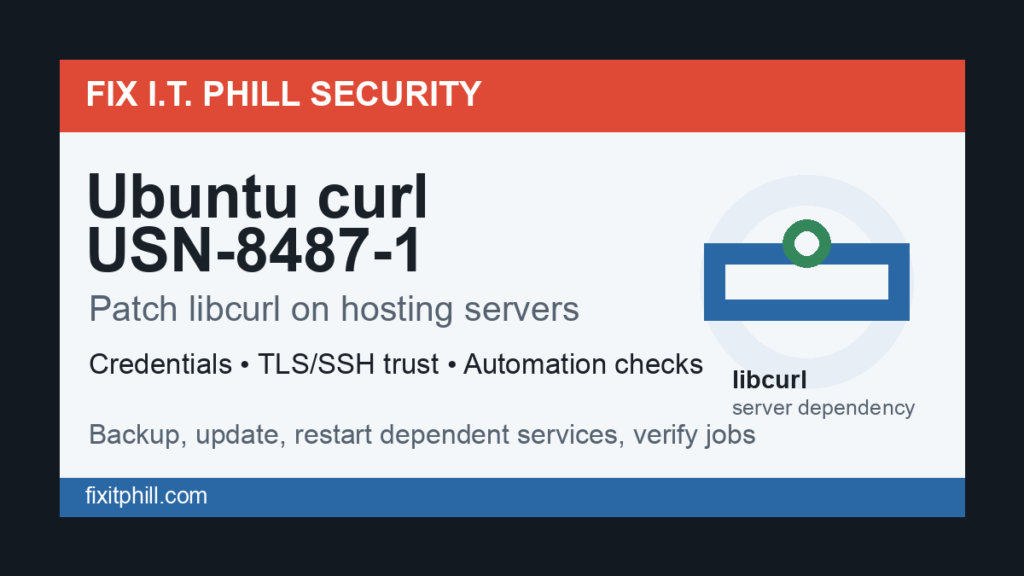
Ubuntu published USN-8487-1 for curl on June 30, 2026. This is worth treating as a hosting maintenance item because curl and libcurl sit under a lot of ordinary server work: update checks, deployment jobs, backup tools, API integrations, monitoring, webhooks, and control-panel adjacent automation.
The Ubuntu advisory says several curl security issues were fixed. The issues include credential exposure risks, connection reuse mistakes, cookie handling problems, SSH/SFTP trust validation problems, denial-of-service risk, and cases where Ubuntu says arbitrary code execution may be possible. This is not only a desktop browser concern; libcurl is commonly embedded in long-running services and automation workers.
Who should patch this first
- Ubuntu servers that run curl or libcurl for deployment, monitoring, backups, API calls, payment or webhook delivery, CDN/origin checks, mail tooling, or software downloads.
- Hosting operators with Ubuntu-based jump boxes, automation nodes, build agents, migration tools, or customer-maintenance scripts.
- WordPress, WooCommerce, and agency teams that rely on Ubuntu cron jobs, external API checks, or managed service integrations outside the WordPress dashboard.
- Container users whose application images include curl or libcurl, even when the host operating system has already been patched.
- Older Ubuntu hosts using Ubuntu Pro or ESM coverage, because USN-8487-1 includes older supported tracks for some of the listed issues.
What Ubuntu fixed
Ubuntu lists ten CVEs in USN-8487-1: CVE-2026-8286, CVE-2026-8458, CVE-2026-8924, CVE-2026-8925, CVE-2026-8926, CVE-2026-8927, CVE-2026-9079, CVE-2026-9080, CVE-2026-9545, and CVE-2026-9547. The affected Ubuntu releases vary by issue, so use the package table in the Ubuntu notice for the exact release and package build you manage.
The practical themes are what matter for most site owners and hosting admins: credential handling, proxy authentication state, cookie boundaries, TLS or STARTTLS connection reuse, HTTP/3 early data, SSH/SFTP host trust, and memory-safety bugs. If your environment uses curl only as a command-line utility, patching is still important. If your application embeds libcurl, plan for service restarts or application redeploys after the package update.
Safe update path for hosting servers
- Take a current backup or snapshot before changing shared production hosts, especially if the server also handles customer sites, billing, DNS, mail, or backup jobs.
- Apply the current Ubuntu security updates from the normal Ubuntu repositories or Ubuntu Pro/ESM path for the release you run.
- Confirm that the installed curl and libcurl packages match the fixed build listed by Ubuntu for that release.
- Restart or recycle long-running services that load libcurl, including queue workers, backup agents, API workers, monitoring daemons, panel integrations, and application containers.
- For containers, rebuild from a patched base image and redeploy. Patching the host does not automatically replace curl or libcurl inside existing images.
- For vendor-managed appliances, control panels, or bundled runtimes, follow the vendor update channel instead of mixing unsupported packages into the stack.
Post-update verification
- Verify that Ubuntu no longer reports pending curl or libcurl security updates for the host.
- Confirm that scheduled backups, CDN/origin checks, API sync jobs, billing integrations, monitoring probes, and webhook deliveries still complete successfully.
- Review application and service logs for new TLS, SSH/SFTP, proxy authentication, API authentication, or redirect failures after the update.
- Check any automation that uses shared proxy credentials, reusable API tokens, or netrc-style credential files. Rotate credentials if logs suggest exposure or unexpected cross-service use.
- For WordPress and WooCommerce environments, test plugin/theme update checks, transactional mail hooks, payment webhooks, license checks, and off-site backup delivery after the maintenance window.
If you cannot patch immediately
Treat delay as temporary risk acceptance, not a mitigation. Reduce the blast radius by limiting outbound automation to trusted services, tightening proxy and API credential scope, separating high-privilege tokens from general maintenance jobs, and moving unsupported Ubuntu releases onto a supported or ESM-covered path. If a server handles customer workloads, document the maintenance plan and verify backups before the change window.
This update also connects to the same maintenance discipline used for web-server and PHP work: patch the package, verify the services that depend on it, and check the public workflow after the change. Related Fix I.T. Phill reading: NGINX security update hosting checklist and PHP 8.3 on Ubuntu with Apache or Nginx.