
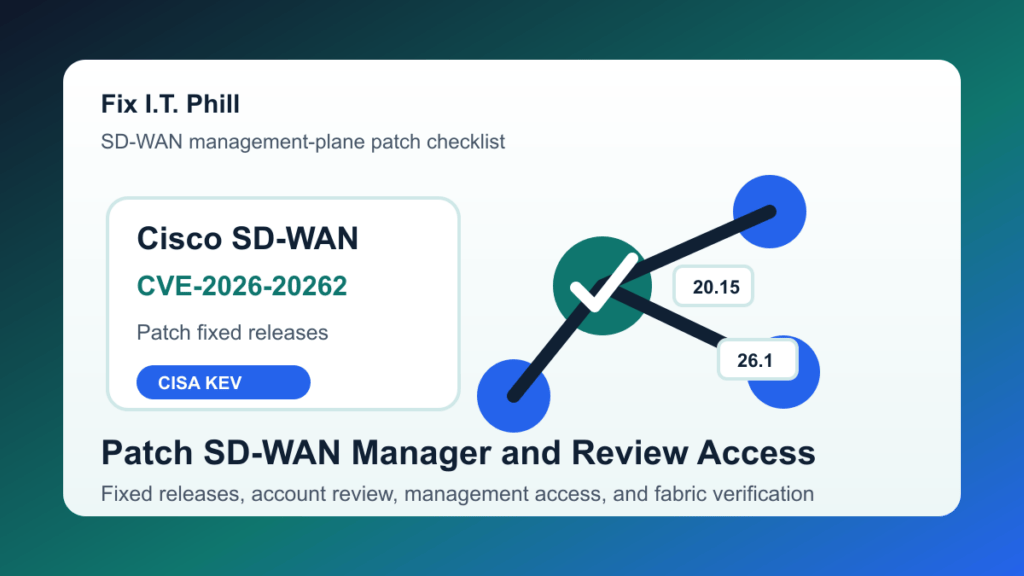
Cisco Catalyst SD-WAN Manager CVE-2026-20262 is now in CISA's Known Exploited Vulnerabilities catalog. CISA added the issue on June 15, 2026, with a due date of June 29, 2026 for covered federal systems. Cisco describes the issue as an arbitrary file write vulnerability in the web UI of Cisco Catalyst SD-WAN Manager, formerly SD-WAN vManage.
This matters for businesses, managed service providers, hosting networks, and distributed offices because SD-WAN Manager is a management-plane system. If a lower-privileged account can be abused on the manager, the right response is not just a software update. It is a patch window, account review, management-access review, and post-change fabric check.
This is a protect-only guide. It explains the safe update and verification path without publishing endpoint details, request examples, scanner material, or investigation recipes that would help someone target a live SD-WAN manager.
What is affected
Cisco says the vulnerability affects Cisco Catalyst SD-WAN Manager regardless of device configuration. Use Cisco's advisory as the source of truth for your exact release train and entitlement path, because the affected-version list is long.
- Cisco Catalyst SD-WAN Manager / SD-WAN vManage deployments on affected software trains.
- Managers reachable from broad admin networks, weakly segmented jump hosts, shared admin workstations, or internet-exposed management paths.
- Deployments with stale local users, over-broad single-task accounts, automation accounts, or identity-provider groups that can reach the manager.
- MSP and hosting-provider environments where SD-WAN management affects customer connectivity, private cloud routing, backups, support access, or branch-office traffic.
Fixed release targets
Cisco's advisory lists these first fixed releases for the major affected trains:
- 20.9 train: first fixed release 20.9.9.2
- 20.12 train: first fixed release 20.12.7.2
- 20.15.4 train: first fixed release 20.15.4.5
- 20.15.5 train: first fixed release 20.15.5.3
- 26.1 train: first fixed release 26.1.1.2
Cisco also says there are no workarounds that address this vulnerability. If you cannot update immediately, reduce management-plane exposure while you schedule the vendor-supported fixed software path.
What to do now
- Inventory SD-WAN Manager instances. Include production, staging, disaster-recovery, lab, and customer-managed deployments.
- Confirm the running version and release train. Match it against Cisco's fixed-release table before choosing the maintenance path.
- Back up before maintenance. Save manager configuration, templates, policies, certificates, controller state, and change-control evidence.
- Restrict management access. Keep SD-WAN Manager behind trusted admin networks, VPN, bastion hosts, and MFA-backed identities. Remove direct internet exposure where it exists.
- Apply the Cisco fixed software path. Follow the vendor-supported upgrade route for the exact train instead of improvising around the manager.
- Review accounts and access. Check local users, single-task accounts, API users, automation accounts, identity-provider groups, emergency accounts, and stale credentials.
- Review recent manager activity. Look for unusual administrator actions, file-management events, template changes, policy changes, and change windows that do not match your records.
- Verify the fabric after patching. Confirm controllers, edges, tunnels, routing, segmentation, monitoring, backups, and customer or branch connectivity are normal.
Hosting and MSP notes
If SD-WAN Manager supports customer locations, office networks, data-center access, remote support, backup replication, or private cloud connectivity, plan this as management-plane maintenance. Tell affected teams what might flap, which sites are in scope, how rollback will work, and who is watching edge-device health during the change.
For MSPs, include customer-impact notes even when the patch itself is expected to be quiet. A small SD-WAN management issue can look like an application outage to the customer, so post-change checks should include expected paths, segmentation, monitoring, and documented service reachability.
Post-patch verification checklist
- SD-WAN Manager reports the expected fixed software release for its train.
- Management access is limited to trusted admin paths and MFA-backed users.
- Recent administrator activity, file-management events, templates, policies, and account changes have been reviewed.
- Controllers, edge devices, tunnels, overlays, routing, segmentation, and site connectivity are healthy.
- Monitoring, alerting, configuration backups, and change records are current after the update.
- Local users, single-task users, API users, automation accounts, break-glass accounts, and stale accounts have been reviewed or tightened.
- Customer or internal stakeholders have been told when the maintenance affects them.
Related Fix I.T. Phill reading
- Cisco SD-WAN Manager CVE-2026-20245 KEV patch guide
- Arista EOS CVE-2026-7473 KEV tunnel decapsulation patch guide
- VMware Cloud Foundation Operations VMSA-2026-0004 patch guide
- How to plan an update window without breaking the site
- How to check backups and restore points
Sources
- CISA Known Exploited Vulnerabilities catalog
- Cisco Security Advisory for CVE-2026-20262
- CVE.org record for CVE-2026-20262
- Official CVE API record for CVE-2026-20262
Need help planning an SD-WAN Manager patch window or checking whether management-plane activity looks normal? Fix I.T. Phill can help review the manager, coordinate the maintenance window, and verify the fabric afterward.
