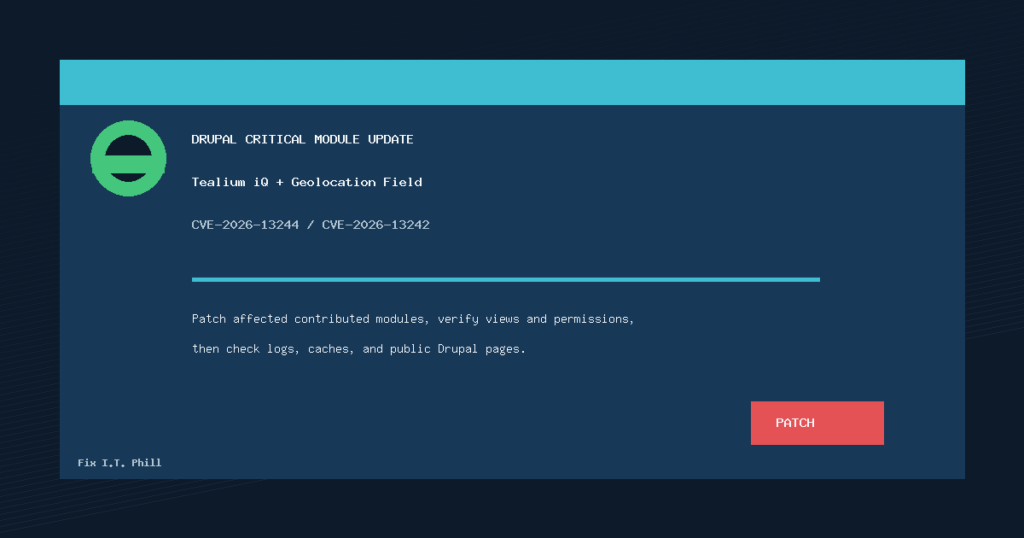
Drupal site owners should check two critical contributed-module advisories from late June 2026. Drupal.org published critical security advisories for Tealium iQ Tag Management and Geolocation Field. Both have fixed versions available, and both are the kind of issue that can hide inside a normal site build because contributed modules often get less attention than Drupal core.
This is a protect-only checklist. It is meant to help site owners, agencies, and hosting teams identify affected Drupal installs, update safely, and verify the site afterward without sharing attack details.
Who Needs To Check
Check any Drupal site that uses either of these modules:
- Tealium iQ Tag Management: versions before 8.x-2.4 are listed as affected by CVE-2026-13244.
- Geolocation Field: versions before 8.x-3.15 are listed as affected by CVE-2026-13242.
If you manage client sites, do not assume this is limited to custom Drupal builds. These modules can appear on marketing sites, ecommerce-adjacent builds, campaign sites, location finders, store locators, intranet tools, and older agency-maintained Drupal installs.
Plain-English Impact
Tealium iQ Tag Management CVE-2026-13244 is a PHP object injection advisory. Drupal notes that risk depends on edit access to content using the affected Tealium field and on site configuration that allows field values to be changed in a risky way. For admins, the practical takeaway is simple: update the module, review who can edit affected content, and review JSON:API permissions if it is enabled.
Geolocation Field CVE-2026-13242 is a SQL injection advisory. Drupal notes that the risky path depends on a view using the affected filter in a way that accepts user input. For admins, update the module and review public-facing views, search pages, maps, store locators, and exposed filters that use geolocation data.
Safe Patch Path
- Confirm a restorable backup of the Drupal codebase, files directory, and database.
- Inventory whether Tealium iQ Tag Management or Geolocation Field is installed and enabled.
- Update Tealium iQ Tag Management to 8.x-2.4 or later if present.
- Update Geolocation Field to 8.x-3.15 or later if present.
- Run the site update workflow your Drupal build uses, then clear Drupal caches.
- Retest content editing, tag-management behavior, maps, exposed filters, search pages, and location pages.
If You Cannot Patch Immediately
If the update cannot be applied during the current window, treat mitigation as temporary. For Tealium iQ, restrict edit permissions for content using the affected field and review JSON:API exposure. For Geolocation Field, review public views that use geolocation filters and remove public exposure from risky filters until the module can be updated.
A WAF or virtual patch can reduce exposure while you schedule maintenance, but it should not be treated as the long-term fix. The long-term fix is to update, test, and keep the module on a supported release path. If a module is no longer maintained in your stack, plan replacement or removal instead of carrying it forward silently.
Post-Update Verification
- Confirm the installed module versions match the fixed releases or later.
- Clear Drupal caches and check recent logs for update errors.
- Test anonymous and authenticated page views that use maps, store locators, search filters, or Tealium output.
- Test editor workflows for content types that include Tealium fields.
- Review CDN, WAF, and application logs for unusual errors after the deployment.
- Tell site owners what changed, what was tested, and whether any temporary permission or view changes remain in place.
Fix I.T. Phill Recommendation
Patch both modules during the next safe maintenance window, sooner for public-facing Drupal sites with content editors, location search, store locator pages, or exposed views. If you host Drupal for clients, add these module checks to the same maintenance queue you use for WordPress plugin and theme updates.