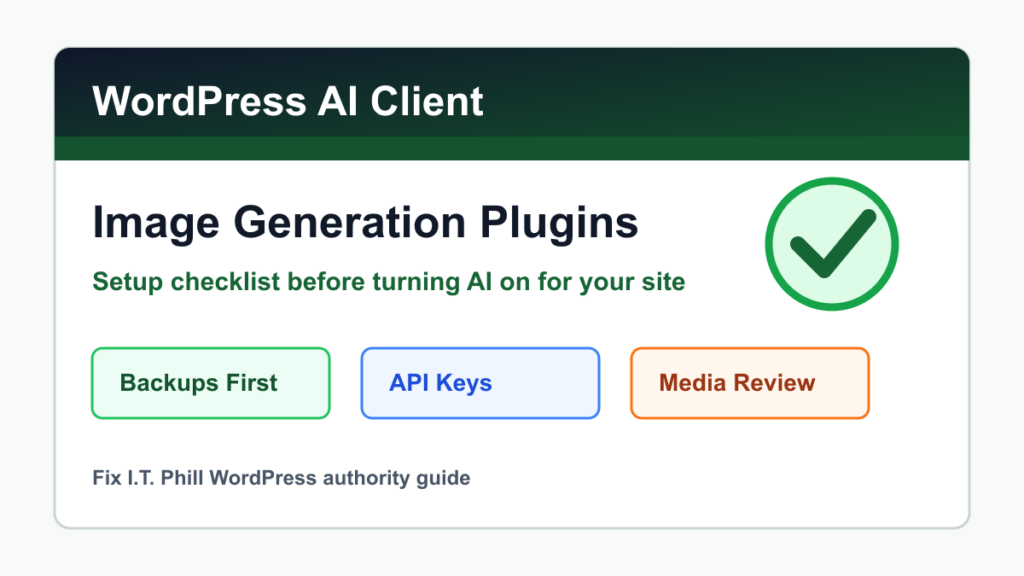
WordPress 7.0 changed the AI plugin conversation. Instead of every plugin asking for its own provider key and inventing its own settings screen, WordPress now includes an AI Client and a Connectors screen that can let site owners manage AI service connections from one place.
That is good news for agencies, business owners, WooCommerce shops, schools, nonprofits, churches, bloggers, and local shops that want useful AI tools without turning the dashboard into a drawer full of mystery keys. It also means the next wave of WordPress plugins can generate images, drafts, excerpts, alt text, layouts, support replies, and other content using a more standard WordPress pattern.
The WordPress Developer Blog published a practical example on May 14, 2026: an image-generation plugin that adds a generation flow inside the Media Library. This Fix I.T. Phill guide is the site-owner version of that lesson: what to check before you install, build, or approve a WordPress AI Client image-generation plugin on a real business website.
What The WordPress AI Client Does
The AI Client is a WordPress 7.0 core API for plugins that need to send prompts to AI providers and receive generated results. The important idea is that the plugin describes what it needs, while WordPress routes the request through a provider that the site owner has configured.
For a site owner, that means the practical setup usually has three layers:
- WordPress core: WordPress 7.0 or later provides the AI Client foundation.
- Connectors: The site owner configures supported AI providers from the WordPress admin instead of scattering API keys across many plugin settings pages.
- AI-aware plugins: Plugins can ask WordPress for image generation, text generation, or other supported AI abilities without hard-coding one provider as the only path.
That does not make every AI plugin automatically safe, cheap, private, or useful. It gives us a better foundation. The rest still needs normal WordPress judgment.
When This Is Worth Installing
An image-generation plugin can make sense when your team regularly needs draft graphics, placeholder images, social artwork, campaign concepts, or quick media assets that will still be reviewed by a human before publishing.
It is not a replacement for a designer, a brand guide, licensed product photography, legal review, or accessibility work. Treat it like a fast creative assistant inside WordPress, not like an autopilot for public-facing brand content.
Before You Install: Quick Decision Checklist
- Is the site on WordPress 7.0 or later? The AI Client is a WordPress 7.0 feature, so older sites need an upgrade plan first.
- Is the site already backed up? Take a fresh backup and know how to restore it before adding AI media or new plugin code.
- Is this going to staging first? Test on staging before production, especially for WooCommerce, membership, LMS, and client sites.
- Who can use it? The example plugin gates the Media Library flow to users who can upload files. That is a sensible minimum, but many businesses should limit AI generation to editors, managers, or trusted admins.
- What provider is configured? Make sure the configured AI provider supports image generation and that the account owner understands cost, retention, and usage limits.
- What data leaves the site? Prompts, image instructions, provider metadata, and possibly generated assets can move through an outside AI service. Do not paste customer records, private files, medical details, legal matters, passwords, or secrets into image prompts.
- How will generated images be reviewed? Decide who checks accuracy, brand fit, copyright risk, accessibility, alt text, and sensitive content before publishing.
- How will storage be controlled? Generated media can fill disk space quickly. Set a cleanup habit for rejected drafts and unused images.
Safe Setup Path For A Business Website
- Update the test site first. Bring a staging copy to WordPress 7.0 or later, update PHP and core plugins, then confirm the admin area, editor, media uploads, forms, and checkout still work.
- Take a restore-tested backup. A backup you have never restored is more like a hope than a plan. Verify files, database, uploads, and plugin settings.
- Choose the AI provider account intentionally. Use a company-controlled provider account, not a random employee login. Turn on billing alerts and usage caps where available.
- Configure the provider in Connectors. Keep AI service connections in the central WordPress connector flow where possible so keys are easier to rotate and audit.
- Install the AI image plugin on staging. Use a plugin built for the WordPress AI Client, or have your developer review the official WordPress Developer Blog example before building custom code.
- Confirm the feature only appears when supported. A good plugin should check whether image generation is actually available before showing buttons to users.
- Generate test images with harmless prompts. Use generic test prompts first. Confirm the plugin shows provider/model details when available, handles errors cleanly, and does not publish automatically.
- Save to the Media Library only after review. The official example separates generation from saving. That is a good pattern because it lets a person approve the image before it becomes a WordPress attachment.
- Add alt text and captions manually. AI can suggest alt text, but your editor should confirm it is accurate and useful for the page.
- Log the production change. Record who enabled the provider, which plugin was installed, who can use it, and how to disable it.
Developer And Agency Notes
If you build WordPress plugins for clients, the AI Client is attractive because it is provider-agnostic. The plugin should ask WordPress for an image-generation capability instead of assuming one exact provider or model will be present on every site.
The WordPress Developer Blog example also points to a pattern every agency should keep: check capability before loading the UI, keep permissions aligned between the admin screen and REST API, and let the user review generated images before saving them into the Media Library. Those boring pieces are what make the feature feel trustworthy in production.
Privacy And Compliance Questions
Before turning on AI media generation for a client or regulated business, answer these questions in plain language:
- Can staff see which AI provider is used?
- Can staff see whether a generated item was saved to the Media Library?
- Does the provider keep prompts or generated media for training, safety review, abuse prevention, or account logs?
- Does the privacy policy need to mention AI-assisted content generation?
- Are employees told not to enter customer personal information, private case details, credentials, or confidential project notes into prompts?
- Can the provider key be rotated quickly if an admin account is compromised?
- Can the plugin be disabled without breaking existing pages?
For most local business sites, the best starting rule is simple: use AI prompts for public-safe creative direction only. Do not use prompts as a dumping ground for private customer context.
Security Checklist
- Use least-privilege WordPress roles. Do not give every author or contributor AI image generation access by default.
- Keep provider API keys out of page builders, theme options, and custom fields.
- Use two-factor authentication on administrator accounts and the AI provider account.
- Rotate provider keys after staff turnover, agency handoffs, or suspected dashboard compromise.
- Review server logs and provider usage if AI costs spike unexpectedly.
- Make sure generated media uploads are handled through normal WordPress media functions, so metadata and thumbnails are created predictably.
- Disable the plugin before troubleshooting high CPU, storage pressure, or unexpected admin errors.
Media Library Workflow
The Media Library is the right place for this feature because it gives editors a familiar review step. A sane workflow looks like this:
- Write a prompt that does not include private data.
- Generate a draft image.
- Review the preview before saving.
- Save only the useful result into the Media Library.
- Add a human-written file name, title, alt text, caption, and page context.
- Remove rejected or unused generated images during monthly maintenance.
That last step matters. AI tools make it easy to create five or ten images when you only needed one. On a small hosting account, that habit turns into wasted disk space and slower media management.
Rollback Plan
Before production launch, write down the rollback steps:
- Deactivate the AI image plugin.
- Remove or rotate the provider connection if needed.
- Check the Media Library for generated images that should be deleted or unpublished.
- Restore the staging or production backup if the plugin caused broader problems.
- Clear page cache and CDN cache after disabling generated content blocks or replacing images.
Who Should Move First
Agencies, publishers, nonprofits, and shops that already have a staging process can test this now. Small businesses without backups, role controls, or a maintenance routine should fix those basics first. The feature is promising, but it should sit on top of a healthy WordPress operation.
Fix I.T. Phill Recommendation
WordPress AI Client image-generation plugins are worth watching because they can make AI features feel more native and less chaotic in WordPress. The winning setup is not “install every AI tool.” It is WordPress 7.0, staging, backups, central connectors, limited permissions, clear privacy rules, and human review before generated media goes live.
Related Fix I.T. Phill Guides
- WordPress 7.0 Safe Upgrade Checklist for Business Sites
- How to Back Up WordPress: Complete Methods Guide
- How to Test a WordPress Backup Restore Before an Emergency
- How to Maintain a WordPress Website: Complete Business Checklist
- How to Build a Small Business WordPress Plugin Stack
- How to Install Help4 Theme Builder and Build WordPress Pages Faster
- How to Install an SSL Certificate for WordPress
- Help4 Network hosting and website support
Sources Checked
- WordPress Developer Blog: How to build an image generation plugin with the WordPress AI Client
- Make WordPress Core: Introducing the AI Client in WordPress 7.0
- WordPress.org News: WordPress 7.0 "Armstrong"
- WordPress.org Plugin Handbook
- WordPress REST API Handbook
- WordPress Media Library support documentation
- WordPress.org Photo Directory Content Guidelines
- FTC: Start with Security, A Guide for Business