XCP-ng published a June 23, 2026 update batch for XCP-ng 8.3 LTS that includes Xen, Linux kernel, and lldpd security fixes. This is not being presented as a panic item by Vates: the XCP-ng post says the fixed vulnerabilities are not considered critical and are being handled as defense-in-depth. Still, the update requires host reboots, so it deserves a real maintenance plan if the pool runs customer sites, control panels, mail, databases, SaaS workloads, or lab infrastructure you care about.
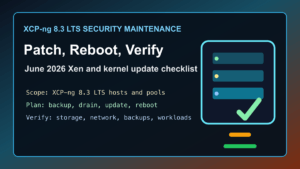
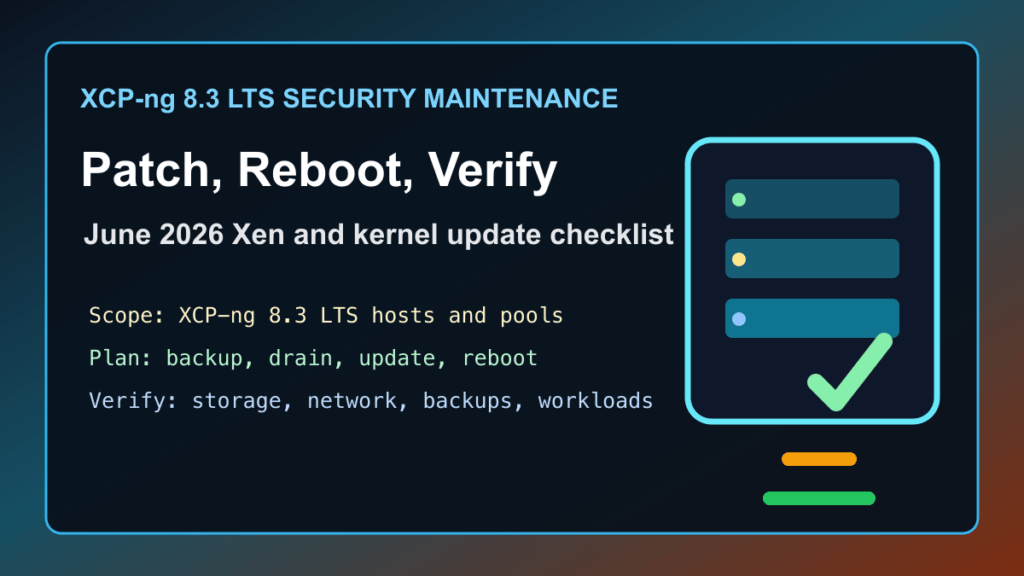
The practical takeaway is simple: treat this as a controlled hypervisor maintenance window. Back up the important guests, drain one host at a time, update through the supported XCP-ng process, reboot, and verify both the host and the workload layer before moving to the next node.
What changed in the June 2026 XCP-ng update batch
The June 2026 Updates #2 batch for XCP-ng 8.3 LTS includes security and maintenance fixes across the hypervisor and base system. Vates specifically references Xen security advisories XSA-491 through XSA-494, a Linux kernel CIFS client local privilege-escalation issue, and an lldpd VLAN-decoding issue affecting an optional package.
For XCP-ng environments, Vates rates the Xen items more narrowly than the generic Xen upstream advisories:
- VSA-2026-017 / XSA-491 / CVE-2026-42487: low severity for Vates products. The upstream issue is tied to x86 HVM guest handling and host stability risk.
- VSA-2026-018 / XSA-492 / CVE-2026-42489 and CVE-2026-42490: low severity for Vates products. The XCP-ng-supported use case limits the practical impact.
- VSA-2026-019 / XSA-493 / CVE-2025-10263: not applicable to XCP-ng according to Vates because the issue affects Arm Xen systems.
- VSA-2026-020 / XSA-494 / CVE-2026-42488: not applicable to XCP-ng according to Vates because the affected PV guest condition is not supported, though the update still carries the fix for alignment.
- VSA-2026-021 / CVE-2026-46243: moderate severity for Vates products. This is the kernel CIFS client issue included in the batch.
- VSA-2026-022: low severity for Vates products. This affects the optional lldpd package when present.
That mix is exactly why the guidance should be measured. This is not a known mass-exploitation story, and XCP-ng is not calling the batch critical. But hosting operators should not ignore hypervisor and control-domain updates just because a vendor rates them low. A low-rated host update can still require careful scheduling because every rebooted node carries availability risk.
Who should prioritize this
Prioritize this update if your XCP-ng 8.3 LTS hosts run public or business-critical workloads, including:
- cPanel, WHM, Plesk, DirectAdmin, WHMCS, DNS, mail, or billing systems.
- Customer VMs, agency client sites, ecommerce stores, database servers, or file servers.
- Xen Orchestra Appliance or backup workers that manage production infrastructure.
- Clusters where live migration, shared storage, or HA behavior needs to be verified after host maintenance.
- Any host with SMB/CIFS client usage in the control domain or with the optional lldpd package installed.
Safe XCP-ng host update plan
Use the vendor-supported update path for XCP-ng. Do not mix random upstream Xen patch files into a production XCP-ng host unless Vates support or your own tested packaging process explicitly tells you to do that. XCP-ng packages should come from the XCP-ng repositories and update workflow.
Before the first host
- Confirm the pool version, host list, pool coordinator, update channel, and whether all hosts are healthy before starting.
- Review Vates’ June 23 update post and the XCP-ng update guide for the current supported process.
- Confirm recent backups for critical guests, especially control panels, billing, DNS, mail, database, customer edge, and management VMs.
- Check whether XOA, backup repositories, shared storage, and management access will remain reachable while one host is down.
- Tell customers or internal stakeholders when VM movement or reboots may affect performance.
During the window
- Patch one host at a time unless the pool is already designed for broader maintenance.
- Drain or migrate guests according to your normal pool workflow before rebooting a host.
- Keep HA, quorum, shared storage, and backup windows in mind. Do not reboot into a known storage or network warning.
- After the host returns, confirm it rejoins the pool cleanly before moving to the next host.
- If you use optional lldpd, verify the package state after the update and confirm network discovery still behaves as expected.
After each host
- Confirm the host reports the expected updated package state through your normal XCP-ng, Xen Orchestra, or XCP-ng Center view.
- Check that guest tools, VM networking, storage repositories, backups, and snapshots still behave normally.
- Verify that important customer VMs are reachable at the application layer, not only that the hypervisor says they are running.
- Watch host and pool logs for storage reconnects, migration warnings, management-agent restarts, and backup job failures.
- Record the host, update time, reboot time, and any VM movement so support has a clean maintenance trail.
XCP-ng vs generic Xen guidance
The upstream Xen advisories matter, but they are not a substitute for product-specific guidance. Generic Xen advisories describe what can be vulnerable in Xen as a project. XCP-ng’s advisory pages map those issues into the supported XCP-ng product model and severity ratings. That is why Vates can rate XSA-493 and XSA-494 as not applicable for XCP-ng while still documenting them and carrying related fixes where appropriate.
If you run another Xen-based platform, such as XenServer, a custom Xen build, or a distribution-packaged Xen host, use that vendor’s advisory and package channel. Do not assume XCP-ng’s low or not-applicable rating applies to a different Xen deployment model.
What Fix I.T. Phill recommends
For XCP-ng 8.3 LTS hosts, schedule the June 2026 update batch during the next practical maintenance window. It is not a drop-everything emergency from the XCP-ng wording, but it is still a hypervisor security and maintenance update that needs backup-first execution and post-reboot verification.
For hosting providers and agencies, the customer-facing message can stay calm: security and maintenance updates are being applied to the virtualization layer, hosts will be patched one at a time, and services will be checked after each host returns.