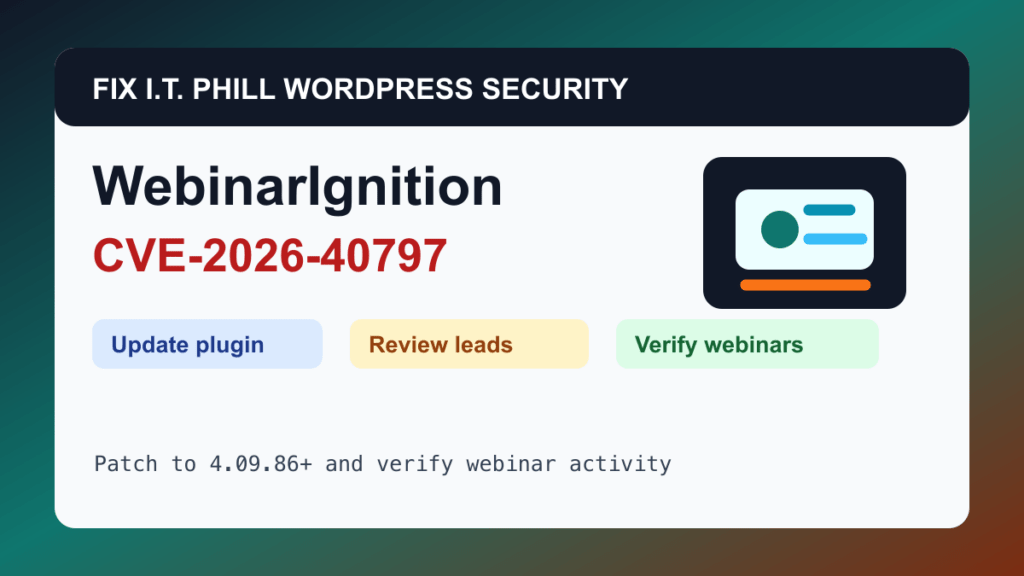
WebinarIgnition CVE-2026-40797 is a high-priority WordPress plugin security issue. Patchstack lists WebinarIgnition versions before 4.09.86 as vulnerable to unauthenticated SQL injection, with a CVSS score of 9.3. The patched version is 4.09.86, and WordPress.org currently shows a newer 4.10.x branch, so the safe maintenance answer is to update to 4.09.86 or newer.
This matters because webinar plugins often handle registrations, lead records, follow-up workflows, WooCommerce offers, email reminders, analytics, webhooks, and event pages. A database-layer flaw in that kind of plugin deserves fast attention even on a small marketing site.
This is a protect-only guide. It explains who is affected, how to patch, what to review afterward, and how hosting providers should handle the update without publishing low-level abuse details.
Affected Sites
- WordPress sites running WebinarIgnition before 4.09.86.
- Sites using WebinarIgnition for live webinars, automated webinars, evergreen webinars, WooCommerce webinar offers, registrations, reminders, analytics, lead capture, or event funnels.
- Agency, cPanel, Plesk, DirectAdmin, multisite, and managed WordPress environments where one plugin may exist across many client sites.
- Business sites that collect attendee names, email addresses, phone numbers, custom registration fields, UTM values, offer activity, or follow-up status through webinar workflows.
What To Update
Update WebinarIgnition to 4.09.86 or newer. If WordPress offers a newer release, use the current release rather than stopping at the first fixed build. In this pass, WordPress.org showed WebinarIgnition 4.10.32 as the current directory version.
Safe Patch Plan
- Take a fresh site backup before updating, especially if the site is running an active webinar campaign, paid webinar, WooCommerce offer, or lead-generation funnel.
- Update the plugin from the WordPress dashboard, WordPress Toolkit, Plesk, cPanel, Softaculous, Installatron, WP-CLI, or the maintenance platform used for the site.
- Clear page cache, object cache, host cache, and CDN cache after the update.
- Test a webinar registration from the public site and confirm the attendee flow works.
- Confirm reminder emails, thank-you pages, live room access, replay access, CTA blocks, WooCommerce checkout behavior, CRM/webhook handoff, and analytics still match the site owner expectations.
- Document the updated version and the verification result for the site owner or client.
What To Review After Updating
- Review recent webinar registrations and lead records for unexpected changes or unusual volume.
- Check WordPress administrator, editor, shop manager, and subscriber accounts for entries that should not exist.
- Check recent plugin, theme, user, page, post, and settings changes from the WordPress dashboard and hosting logs.
- Review webinar pages, thank-you pages, replay pages, embedded checkout areas, and tracking scripts for unexpected edits.
- Confirm the site is collecting only the attendee information the business actually needs.
- If the site is high-value, ask the host or maintenance provider to review recent database and application activity at a high level.
Temporary Mitigation If You Cannot Update
If you cannot update immediately, pause public webinar registration pages, disable inactive webinar campaigns, restrict access to webinar pages that do not need to be public, and schedule a maintenance window. If the plugin is no longer actively used, disable it until you can update, test, or replace the workflow.
Hosting Provider And Agency Checklist
- Search managed WordPress fleets for WebinarIgnition and record the installed version.
- Prioritize sites with active registration forms, ecommerce offers, paid webinars, CRM handoffs, membership users, or high-value lead funnels.
- Patch the plugin, clear caches, and verify one end-to-end webinar registration flow per production site.
- Tell site owners what changed, what was tested, and whether any suspicious activity needs follow-up.
- Keep any virtual patching or edge filtering notes private and focused on defensive monitoring while the update is being completed.
Exploitation Status
During this pass, the sources checked did not show a confirmed active abuse campaign. Patchstack still rates the issue as high priority and warns that this type of issue is commonly attractive for broad website attacks, so the practical action is to patch now and verify the webinar workflow afterward.
Related Fix I.T. Phill Guides
- How to Back Up WordPress: Complete Methods Guide
- How to Restore WordPress: Complete Recovery Methods Guide
- How to Install WordPress: Complete Methods Guide
- How to Add Business Features to WordPress: Complete Plugin Setup Guide
- How to Add CRM Lead Capture to WordPress
- How to Add an Events Calendar to WordPress
- How to Update WordPress Plugins, Themes, and Core Safely
- Help4 Network hosting and website support