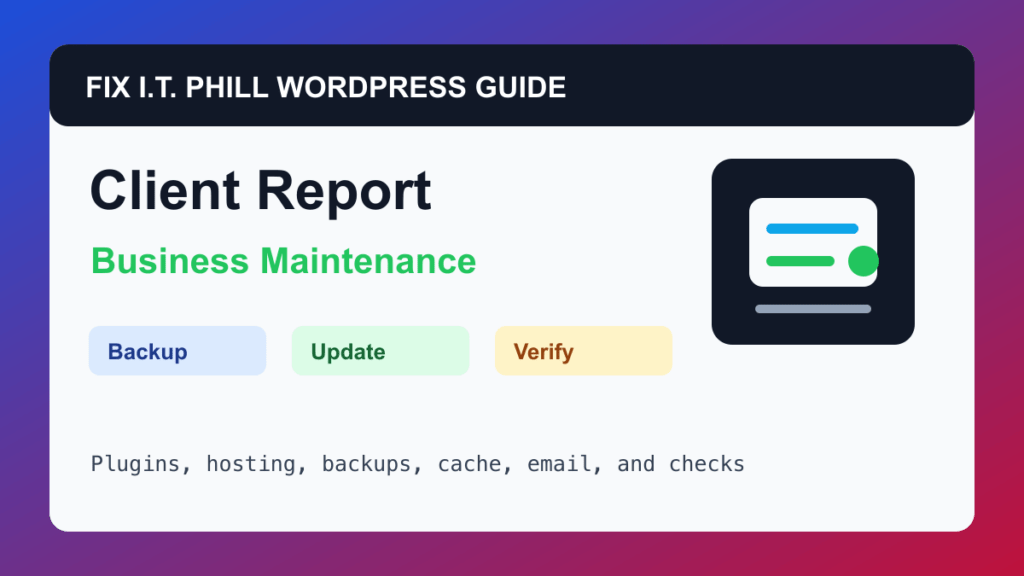
Write a WordPress Maintenance Report for Clients is a practical maintenance workflow for freelancers, agencies, hosts, and internal IT teams that need to show useful maintenance work without overwhelming business owners.
A WordPress maintenance plan should prove the site still works after updates. That means checking the business workflow, hosting layer, plugins, backups, cache, email, and access before a small issue becomes an outage.
When To Run This Check
Write this monthly for managed sites and after every meaningful update, repair, migration, or security cleanup.
Before You Start
- Keep private credentials out of reports.
- Separate completed work, findings, risks, and recommended next actions.
- Use screenshots only when they help explain a result.
- Do not include sensitive client information, private logs, or unnecessary internal details.
Maintenance Steps
- Summarize updates applied and versions changed.
- List backups checked and whether restore confidence is acceptable.
- Document forms, email, checkout, login, cache, SEO, and uptime checks.
- Flag abandoned plugins, license renewals, domain renewals, PHP changes, or hosting limits.
- Give the client a short action list with owners and dates.
Hosting And Control Panel Notes
- Reports should include hosting panel, DNS, email, CDN, backup, and WordPress findings when they affect reliability.
- For ecommerce, note order testing and any avoided high-traffic windows.
- For regulated or professional sites, keep access and privacy notes concise and controlled.
Verify It Works
Confirm the client can understand what changed, what is healthy, what is risky, and what decision is needed next.
Backup And Rollback Notes
- Take a backup before changing plugins, themes, PHP, cache, DNS, checkout, forms, email, or user access.
- Use staging for risky changes on ecommerce, membership, booking, LMS, high-lead, or high-traffic sites.
- Keep rollback ownership clear: who restores, who approves, and how the site is verified afterward.
- Document the maintenance window and preserve version notes for future troubleshooting.
Related Fix I.T. Phill Guides
- WordPress Maintenance Checklist Hub
- How to Back Up WordPress: Complete Methods Guide
- How to Restore WordPress: Complete Recovery Methods Guide
- How to Migrate WordPress: Complete Hosting Move Guide
- How to Install WordPress: Complete Methods Guide
- How to Add Business Features to WordPress: Complete Plugin Setup Guide
- How to Build a WordPress Website for Any Business: Industry Setup Guide
- WordPress 7.0 Safe Upgrade Checklist for Business Sites
- Help4 Network hosting and website support