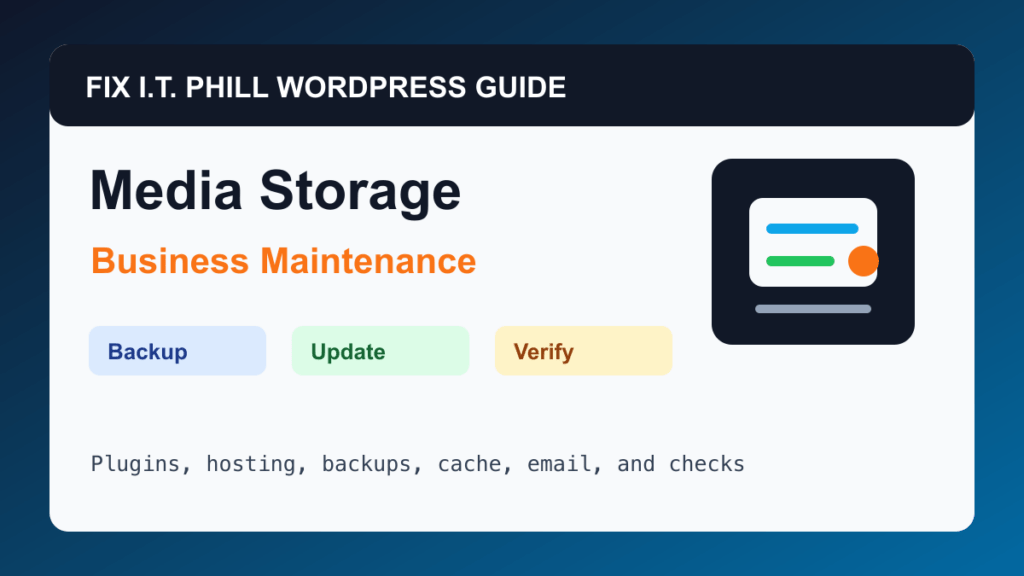
Check WordPress Media, Image Sizes, and Storage is a practical maintenance workflow for site owners with large image libraries, portfolios, ecommerce catalogs, PDFs, videos, or hosting storage warnings.
A WordPress maintenance plan should prove the site still works after updates. That means checking the business workflow, hosting layer, plugins, backups, cache, email, and access before a small issue becomes an outage.
When To Run This Check
Run this quarterly and before migrations, redesigns, gallery changes, product imports, and hosting plan changes.
Before You Start
- Back up media files before bulk compression, deletion, or offload changes.
- Identify original files that should be preserved outside WordPress.
- Check disk usage in the hosting panel.
- Avoid deleting unattached media until content, builders, galleries, and product images are reviewed.
Maintenance Steps
- Review large uploads, duplicate images, unused PDFs, and old marketing files.
- Check whether image sizes are reasonable for page layout.
- Update image alt text on important business pages and products.
- Confirm galleries, featured images, logos, icons, and product photos still display.
- Use CDN or image optimization after preserving originals.
Hosting And Control Panel Notes
- cPanel, Plesk, managed hosts, and backup tools may all report storage differently.
- Large media libraries can slow backups, restores, migrations, and malware scans.
- Offload plugins need a rollback plan before originals are removed locally.
Verify It Works
Confirm media displays correctly, priority images have useful alt text, backups still complete, and storage warnings are understood.
Backup And Rollback Notes
- Take a backup before changing plugins, themes, PHP, cache, DNS, checkout, forms, email, or user access.
- Use staging for risky changes on ecommerce, membership, booking, LMS, high-lead, or high-traffic sites.
- Keep rollback ownership clear: who restores, who approves, and how the site is verified afterward.
- Document the maintenance window and preserve version notes for future troubleshooting.
Related Fix I.T. Phill Guides
- WordPress Maintenance Checklist Hub
- How to Back Up WordPress: Complete Methods Guide
- How to Restore WordPress: Complete Recovery Methods Guide
- How to Migrate WordPress: Complete Hosting Move Guide
- How to Install WordPress: Complete Methods Guide
- How to Add Business Features to WordPress: Complete Plugin Setup Guide
- How to Build a WordPress Website for Any Business: Industry Setup Guide
- WordPress 7.0 Safe Upgrade Checklist for Business Sites
- Help4 Network hosting and website support