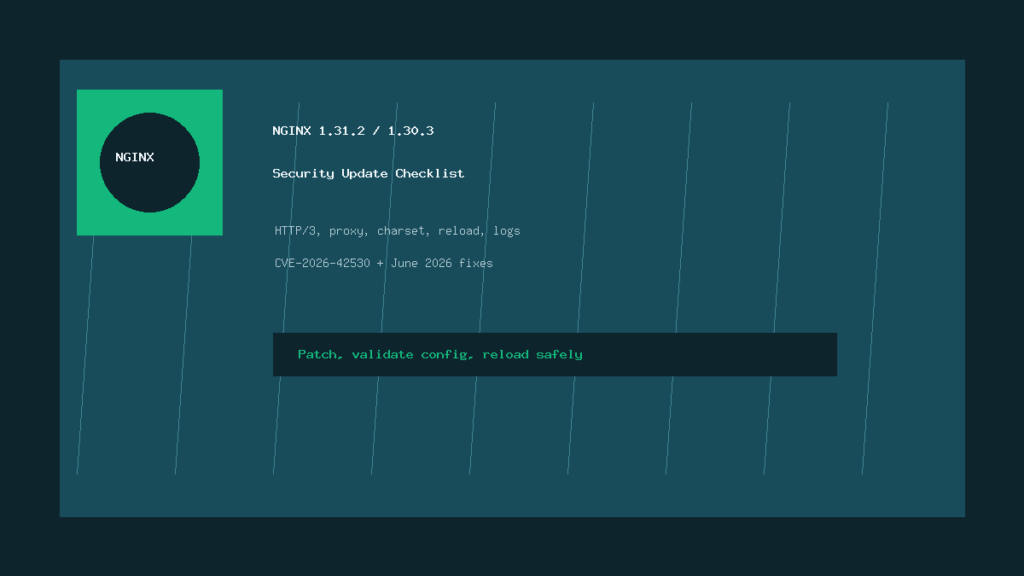
June 24, 2026 update: NGINX has June 2026 security fixes in the 1.31.2 mainline release and 1.30.3 stable release. Hosting providers, SaaS teams, agencies, and site owners running their own reverse proxies should schedule an update window instead of waiting for the next unrelated server maintenance cycle.
Plain-English Impact
The most important item for modern edge stacks is CVE-2026-42530, a major HTTP/3 issue fixed in NGINX 1.31.2. NGINX also lists additional June fixes for proxy or gRPC backend handling and charset processing, including CVE-2026-42055 and CVE-2026-48142. The practical risk is worker-process instability, memory corruption, or limited data exposure depending on version, branch, and configuration.
Who Should Check
- Servers using NGINX mainline 1.31.0 or 1.31.1, especially if HTTP/3 or QUIC is enabled.
- Servers on older stable packages where the vendor has not yet backported the 1.30.3 fixes.
- Reverse proxies in front of WordPress, WooCommerce, WHM/cPanel, Plesk, app servers, gRPC services, or CDN origins.
- Hosting clusters where customers can enable custom NGINX, proxy, charset, or web-app routing behavior.
Patch Path
Move mainline systems to NGINX 1.31.2 or newer. Move stable systems to NGINX 1.30.3 or a distro package that documents the same fixes. If your OS vendor backports NGINX security fixes without changing the upstream version number, confirm the package changelog instead of relying only on the visible NGINX version string.
Safe Maintenance Checklist
- Before patching: record the current NGINX package, enabled modules, HTTP/3 status, upstream proxy paths, certificates, active CDN or load-balancer routing, and rollback package availability.
- Back up first: save NGINX configuration, virtual host files, TLS settings, stream configuration, and any control-panel generated templates before changing packages.
- Validate configuration: run the normal NGINX config test for your platform before reloading, and keep console or provider access available in case a reload fails.
- Reload safely: use a planned reload or rolling restart, drain high-traffic backends where possible, and watch error logs, upstream health checks, CDN origin status, and application logs during the first traffic window.
- After patching: confirm public HTTPS, HTTP/2, HTTP/3 where enabled, gRPC or API routes, WordPress admin, WooCommerce checkout, uploads, cache purge behavior, and origin-to-CDN headers.
Temporary Mitigation
If you cannot patch immediately, reduce exposure while scheduling the update. Review whether HTTP/3 is required on the affected host, restrict management access, avoid risky custom proxy changes during the window, keep WAF and CDN protections enabled, and monitor for abnormal worker crashes or 5xx spikes. Treat this as a short-term bridge, not a replacement for the fixed NGINX package.
Exploitation Status
Fix I.T. Phill did not confirm active exploitation during this pass, and the CISA Known Exploited Vulnerabilities catalog did not change from the June 23 version checked in this scan. This post is based on official NGINX security and release documentation, so administrators should still patch according to exposure and maintenance risk.
Sources
For related planning, keep this paired with Fix I.T. Phill’s Ubuntu LEMP hardening checklist, LEMP WordPress server checklist, and WordPress maintenance-window guide.