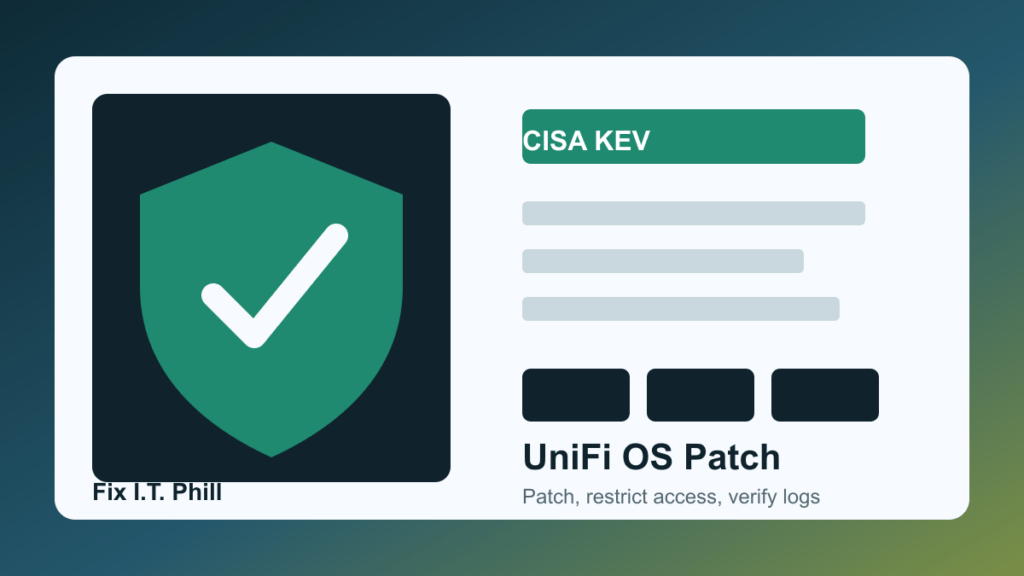
June 23, 2026 update: CISA added CVE-2026-34908, CVE-2026-34909, and CVE-2026-34910 affecting Ubiquiti UniFi OS to the Known Exploited Vulnerabilities catalog. CISA lists a June 26, 2026 remediation due date for federal agencies, which is also a useful emergency timeline for MSPs, schools, churches, small businesses, agencies, and hosting teams that administer UniFi networks.
Plain-English impact: UniFi OS controls gateways, consoles, network appliances, cameras, access control, and management services for many small and mid-sized networks. If an exposed or poorly restricted UniFi management plane is compromised, the attacker may be able to take over network management, change routing or firewall behavior, weaken tenant isolation, view device inventory, or use the network appliance as a foothold.
This is a protect-only guide. It summarizes the update and verification path without publishing operational exploit details from public research.
Who should act
- Admins running UniFi OS consoles, gateways, Cloud Keys, NVR appliances, or hosted UniFi OS Server installs.
- MSPs and agencies that manage multiple customer UniFi sites from shared admin workstations.
- Small businesses that expose UniFi management to the internet for convenience.
- Schools, churches, nonprofits, warehouses, retail stores, and hospitality networks using UniFi for Wi-Fi, cameras, access, or routing.
- Hosting or SaaS teams that place UniFi management on the same trusted network as customer systems, backups, monitoring, or admin tools.
Patch and containment path
- Inventory every UniFi OS system. Include customer sites, lab appliances, retired-but-powered gear, hosted UniFi OS Server installs, and emergency spares.
- Check the exact model and UniFi OS version. Ubiquiti Security Advisory Bulletin 064 lists affected products and fixed releases by platform. Do not assume every appliance uses the same fixed version.
- Back up the UniFi configuration first. Save a current console backup and keep the local owner credentials available before patching remote sites.
- Update from the official UniFi OS path. Use the UniFi console update workflow or Ubiquiti-supported download path for your platform. Avoid unofficial firmware images.
- Restrict management access. Remove public internet exposure where possible. Use VPN, trusted IP allowlists, SSO/MFA where available, and separate admin networks.
- Review admin accounts and sessions. Remove unknown users, stale MSP accounts, unused local admins, and shared passwords. Rotate credentials for accounts used from exposed admin workstations.
- Check logs and network changes. Review recent admin logins, firmware changes, firewall edits, new remote access rules, device adoption events, VPN changes, and unexpected reboots.
Hosting and MSP notes
For MSPs and hosting teams, the management plane matters as much as the firmware version. Patch the appliance, then verify that management access is not reachable from public networks, guest Wi-Fi, customer VLANs, shared hosting segments, or contractor laptops. If one admin workstation can reach many customer UniFi consoles, treat that workstation as a high-value system and review browser sessions, saved passwords, remote access tools, and MFA status.
For customer communication, keep the message practical: this is a network management security update, not a website content change. Tell customers whether Wi-Fi, cameras, VPN, or routing may briefly restart, and document the firmware version verified afterward.
June 24 NVD version check
June 25, 2026 refresh: NVD now shows all three UniFi OS CVEs as 10.0 Critical based on the CNA score and lists affected version ranges that give admins a clearer minimum-version check. CISA also lists these CVEs in KEV, which means this should be treated as active-exploitation patch work, not routine firmware hygiene.
- UniFi OS Server: update to 5.0.8 or later.
- Most UniFi OS consoles, Cloud Gateways, Cloud Keys, Dream Machine, Dream Router, Dream Wall, and NVR families: update to 5.1.12 or later unless Ubiquiti lists a different fixed version for your exact model.
- UDM Beast: NVD lists the affected range as versions before 5.1.11.
- UNAS family: NVD lists the affected range as versions before 5.1.10.
- UniFi Express: for CVE-2026-34909, NVD lists the affected range as versions before 4.0.14.
Use the UniFi console update screen, Ubiquiti’s official release channel, or your MSP inventory tool to confirm the actual installed build. After updating, verify that remote management exposure is restricted, review recent admin users and configuration changes, and confirm that firewall, VPN, camera, storage, and site-to-site services are still behaving normally.
Post-update verification
- The UniFi OS version matches the fixed release for that exact model in Ubiquiti’s advisory.
- Management access is limited to trusted paths and is not exposed casually to the public internet.
- Local and cloud admin users are expected, named, and protected with strong authentication.
- Firewall, VPN, port forwarding, DNS, and remote access settings still match the intended design.
- Wi-Fi, guest networks, cameras, access devices, VLANs, DHCP, and WAN failover behave normally after the update.
- Backups exist and can be found by the person who will be called during the next maintenance window.
If you cannot patch immediately
Use temporary controls only as a bridge. Remove public management exposure, limit access to a trusted VPN or admin network, disable unused remote access paths, increase logging, and schedule the firmware update as emergency maintenance. Do not treat a firewall rule or WAF rule as the final fix for an affected UniFi OS system.
Related Fix I.T. Phill reading
- SolarWinds Serv-U CVE-2026-28318 KEV patch guide
- Langflow CVE-2026-5027 AI app server patch guide
- How to Check WordPress Backups and Restore Points
Sources
- CISA Known Exploited Vulnerabilities catalog
- Ubiquiti Security Advisory Bulletin 064
- NVD entry for CVE-2026-34908
- NVD entry for CVE-2026-34909
- NVD entry for CVE-2026-34910
Need help checking a UniFi environment after this advisory? Fix I.T. Phill can help inventory consoles, lock down management access, plan customer-safe firmware maintenance, and verify routing, Wi-Fi, VPN, and backup state after the update.