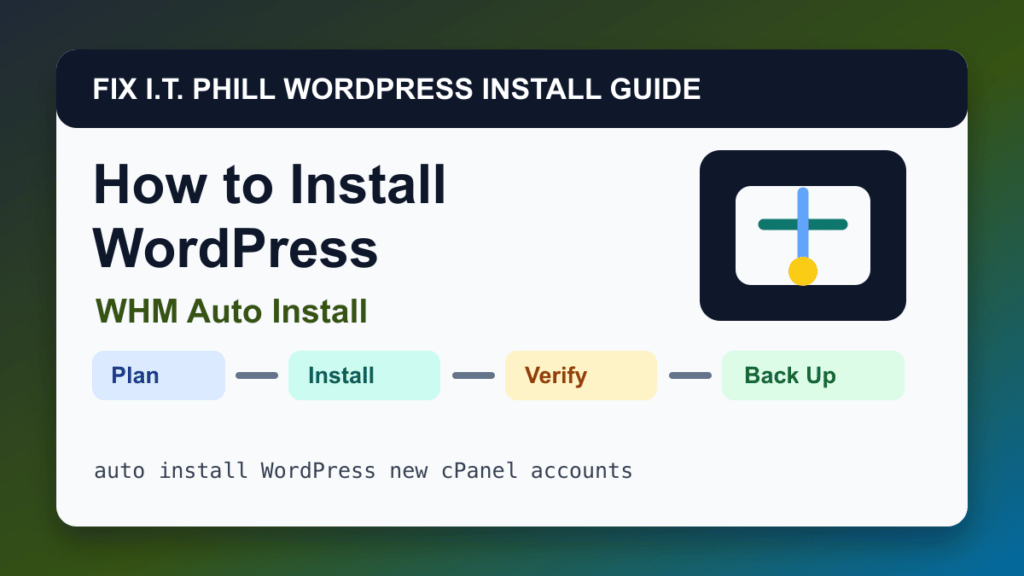
WHM account automation with WP Toolkit is a good WordPress installation path when it matches the host and future maintenance plan. This method is best for repeatable new-account WordPress provisioning with a standard plugin/theme set and safer defaults.
Audience: web hosts, resellers, agencies, and admins provisioning many WordPress cPanel accounts. Before installing, decide who owns the site, where backups live, how updates happen, and what will happen if the first plugin or theme choice breaks the site.
Before install
- Decide whether every new account should receive WordPress or only selected packages.
- Prepare a standard update, backup, security, and plugin baseline.
- Avoid shared default passwords or reused admin names.
- Test automation on a disposable account before using it for customers.
Install steps
- Confirm WP Toolkit is installed and visible in WHM and cPanel.
- Create a provisioning plan for domains, packages, PHP, SSL, and default resources.
- Use the official cPanel automation guidance as the implementation reference.
- Install WordPress with customer-specific credentials and email addresses.
- Apply the standard plugin/theme set only when it is truly needed.
- Verify the created account and site before handing it to the customer.
Post-install verification
Check the new cPanel account, WordPress login, SSL, update settings, backup policy, email routing, resource limits, and support notes for the customer.
Also confirm public pages return 200, the dashboard loads over HTTPS, the administrator email can receive password resets, updates are visible, and a backup exists before you start building heavily.
Install risks
- Automation can multiply a bad default across many accounts.
- Default content and unused plugins can create maintenance debt.
- A failed provisioning script can leave partial installs that need cleanup.
Backup and rollback planning
A new WordPress site still needs a rollback plan. Create the first backup before installing large themes, builders, ecommerce extensions, membership tools, LMS plugins, or custom code. If this install is for a customer, document the host, login ownership, backup location, update policy, and launch checklist.
Fix I.T. Phill recommendation
Use WHM account automation with WP Toolkit when it gives you the cleanest path to updates, backups, SSL, and support. Keep the install lean, verify it publicly, and connect it to the backup, restore, and migration guides before the site becomes important.
Related Fix I.T. Phill Guides
- How to Install WordPress: Complete Methods Guide
- How to Install WordPress by cPanel WP Toolkit
- How to Install WordPress by Plesk WP Toolkit
- How to Install WordPress by Softaculous
- How to Install WordPress by Installatron
- How to Install WordPress by DirectAdmin WordPress Manager
- How to Install WordPress Manually in cPanel
- How to Install WordPress Manually with SFTP and phpMyAdmin
- How to Back Up WordPress: Complete Methods Guide
- How to Restore WordPress: Complete Recovery Methods Guide
- How to Migrate WordPress: Complete Hosting Move Guide
- WordPress 7.0: Safe Upgrade Checklist for Business Sites
- Install essential PHP extensions for WordPress in WHM/cPanel
- Help4 Network hosting and website support