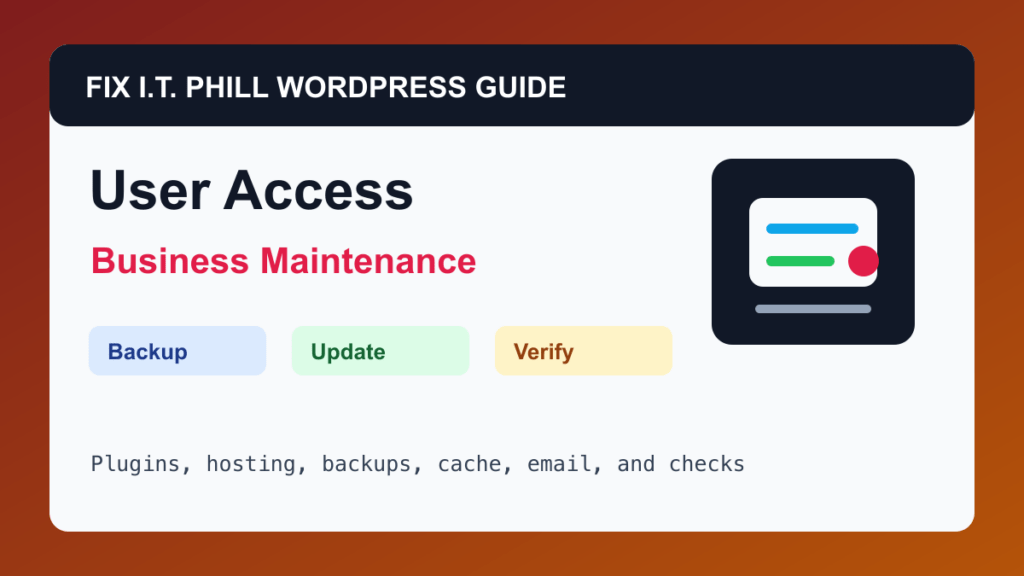
Review WordPress Users and Admin Access is a practical maintenance workflow for business owners, web hosts, agencies, ecommerce teams, and nonprofits that need fewer stale admin accounts.
A WordPress maintenance plan should prove the site still works after updates. That means checking the business workflow, hosting layer, plugins, backups, cache, email, and access before a small issue becomes an outage.
When To Run This Check
Run this monthly for high-risk sites and quarterly for normal business sites.
Before You Start
- Export or document current administrators before changing roles.
- Confirm which accounts belong to employees, vendors, agencies, developers, and automation tools.
- Back up before bulk user cleanup on membership, LMS, WooCommerce, or community sites.
- Do not delete users that own important content until reassignment is planned.
Maintenance Steps
- Review administrator and editor accounts first.
- Remove or downgrade accounts that no longer need access.
- Require strong passwords and multi-factor authentication where available.
- Check application passwords and integration accounts.
- Document who owns emergency access and who approves new admin users.
Hosting And Control Panel Notes
- Also review cPanel, Plesk, FTP, SFTP, database, DNS, CDN, email, and backup-provider access.
- Agency handoffs should include account ownership, license ownership, and recovery email ownership.
- Client reports should list access changes without exposing private credentials.
Verify It Works
Confirm current staff can still work, removed users cannot log in, content authorship remains intact, and emergency access is documented.
Backup And Rollback Notes
- Take a backup before changing plugins, themes, PHP, cache, DNS, checkout, forms, email, or user access.
- Use staging for risky changes on ecommerce, membership, booking, LMS, high-lead, or high-traffic sites.
- Keep rollback ownership clear: who restores, who approves, and how the site is verified afterward.
- Document the maintenance window and preserve version notes for future troubleshooting.
Related Fix I.T. Phill Guides
- WordPress Maintenance Checklist Hub
- How to Back Up WordPress: Complete Methods Guide
- How to Restore WordPress: Complete Recovery Methods Guide
- How to Migrate WordPress: Complete Hosting Move Guide
- How to Install WordPress: Complete Methods Guide
- How to Add Business Features to WordPress: Complete Plugin Setup Guide
- How to Build a WordPress Website for Any Business: Industry Setup Guide
- WordPress 7.0 Safe Upgrade Checklist for Business Sites
- Help4 Network hosting and website support