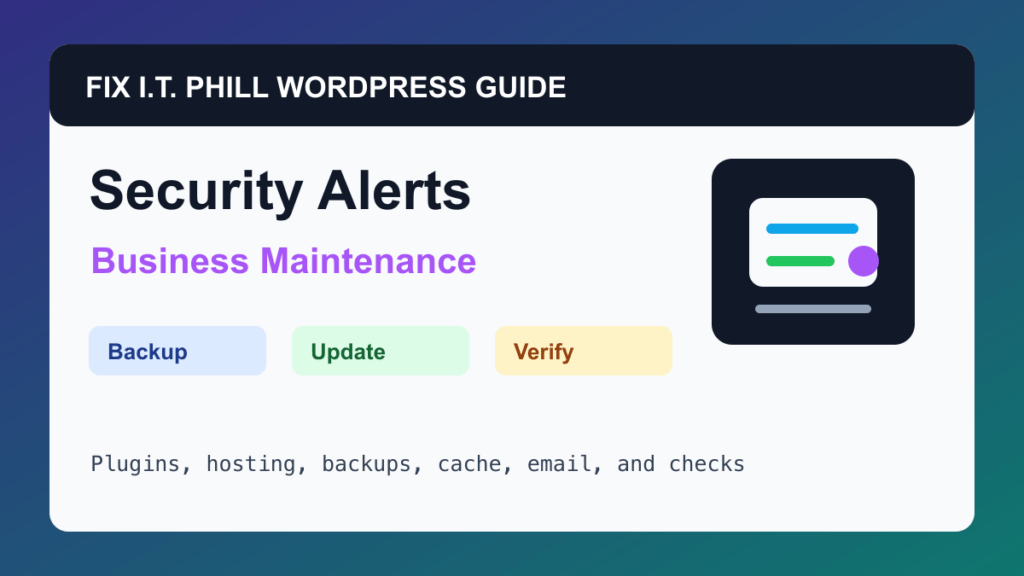
Check WordPress Security Plugin Alerts is a practical maintenance workflow for site owners who run a security plugin but need a practical monthly review process instead of ignoring alert emails.
A WordPress maintenance plan should prove the site still works after updates. That means checking the business workflow, hosting layer, plugins, backups, cache, email, and access before a small issue becomes an outage.
When To Run This Check
Run this weekly for ecommerce and membership sites, and monthly for standard business sites.
Before You Start
- Know which security plugin is active and who receives alerts.
- Back up before changing firewall, login, or file-integrity settings.
- Separate plugin update notices from signs of active compromise.
- Do not panic-publish security claims from a single dashboard alert without vendor confirmation.
Maintenance Steps
- Review critical alerts first: outdated vulnerable plugins, unknown admin users, file changes, malware notices, and blocked login spikes.
- Update affected plugins from trusted sources when a fixed version exists.
- Check recent admin users, plugin installs, theme edits, and file changes.
- Review web host malware scans or Imunify-style alerts when available.
- Escalate suspicious findings to a clean-room review instead of editing live files blindly.
Hosting And Control Panel Notes
- Hosting-layer security, WAF, backup, CDN, and WordPress security plugin alerts should be compared, not treated as separate worlds.
- If a plugin is abandoned, plan replacement instead of relying only on virtual patching.
- Keep alert routing tied to a monitored mailbox.
Verify It Works
Confirm alerts are acknowledged, fixed versions are installed where available, no unexpected admin access remains, and the site still functions after cleanup.
Backup And Rollback Notes
- Take a backup before changing plugins, themes, PHP, cache, DNS, checkout, forms, email, or user access.
- Use staging for risky changes on ecommerce, membership, booking, LMS, high-lead, or high-traffic sites.
- Keep rollback ownership clear: who restores, who approves, and how the site is verified afterward.
- Document the maintenance window and preserve version notes for future troubleshooting.
Related Fix I.T. Phill Guides
- WordPress Maintenance Checklist Hub
- How to Back Up WordPress: Complete Methods Guide
- How to Restore WordPress: Complete Recovery Methods Guide
- How to Migrate WordPress: Complete Hosting Move Guide
- How to Install WordPress: Complete Methods Guide
- How to Add Business Features to WordPress: Complete Plugin Setup Guide
- How to Build a WordPress Website for Any Business: Industry Setup Guide
- WordPress 7.0 Safe Upgrade Checklist for Business Sites
- Help4 Network hosting and website support