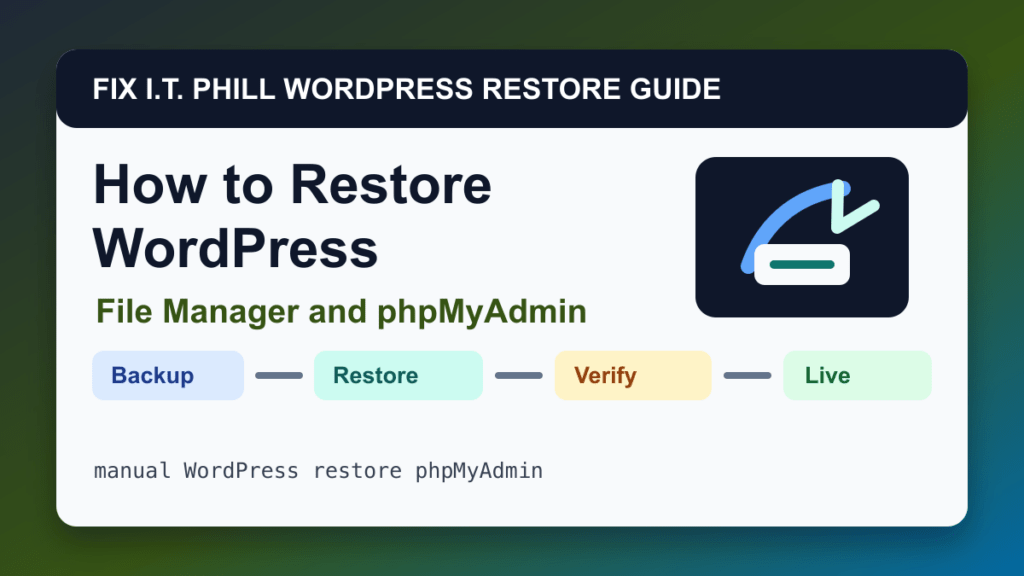
File Manager and phpMyAdmin can restore WordPress safely when you understand what it will overwrite. This method is best for single-site recovery, migrations, and restoring from a zip plus SQL backup.
Audience: site owners, support teams, and developers restoring one WordPress site without a one-click restore tool. Use this with the matching backup method whenever possible. If you did not create the backup yourself, verify the backup date, scope, and site path before restoring production.
Before restore
- Keep the current broken site in a separate folder or archive before replacing files.
- Create a fresh empty database or confirm the target database can be overwritten.
- Know whether the backup URL matches the current live URL.
Restore steps
- Upload and extract the WordPress files backup into the document root.
- Import the SQL backup into the correct database with phpMyAdmin.
- Update wp-config.php with the database name, user, password, and host.
- If the domain changed, update URLs using a safe search-replace workflow.
- Reset file ownership or permissions if uploads, plugins, or updates fail.
- Log in and resave permalinks if routes return 404.
Post-restore verification
Check visible pages, images, plugin screens, admin login, users, forms, and the WordPress Site Health screen. Review error logs if the site loads partially.
Also check server and application logs, cache layers, CDN behavior, SSL, redirects, and whether scheduled tasks still run. A restore is not complete just because the home page loads.
Restore risks
- Importing SQL into the wrong database.
- Extracting files one directory too deep.
- Breaking serialized data with unsafe text replacement.
- Leaving backup zip or SQL files in public_html.
Rollback planning
Before restoring, keep the current state long enough to recover anything the restore might erase. For stores and membership sites, that means orders, subscriptions, users, payments, form submissions, bookings, and logs. For agencies and hosts, it also means customer communication and a timestamped maintenance note.
Fix I.T. Phill recommendation
Use File Manager and phpMyAdmin when it matches how the backup was created. If the restore tool is not available, fall back to files plus database restore, but test on staging first. After restore, update the backup plan so the next recovery is easier.
Related Fix I.T. Phill Guides
- How to Restore WordPress: Complete Recovery Methods Guide
- How to Restore WordPress by cPanel Backup Wizard
- How to Restore WordPress by WHM Full Account Restore
- How to Restore WordPress by cPanel WP Toolkit
- How to Restore WordPress by Plesk WP Toolkit
- How to Restore WordPress by Plesk Backup Manager
- How to Restore WordPress by Softaculous
- How to Back Up WordPress: Complete Methods Guide
- How to Back Up WooCommerce Without Losing Orders
- How to Test a WordPress Backup Restore Before an Emergency
- Disable WordPress plugins with phpMyAdmin when wp-admin is broken